
Entry-Level AI Smart Glasses That Still Carry Real Specs: How Buyers Should Judge Cost-Per-Feature in 2026
Introduction: Why This Question Matters to You
The entry tier is the fastest-moving part of the AI Smart glasses market, and the easiest place to buy badly. Two suppliers can quote very different prices for what looks like the same product on a landing page, because the differences that matter are hidden behind the headline: a sensor that is eight megapixels in silicon but one megapixel in output, an image stabilisation claim that only applies to stills, a microphone array listed as stereo, a battery quoted as music playback time instead of recording time.
Cost-per-feature is the only honest way to compare this segment. It means one question, asked per line of the specification: what does this number buy me, and can I verify it with a sample in my hand? A cheap platform that fails that test is not cheap, because the returns, the review complaints and the rework all arrive after the container ships.
This guide sets out how the entry tier is actually built, where suppliers trim cost and where trimming becomes damage, what to compare line by line, and how a sample becomes a repeat order. It uses the SC01 platform as the worked example, because that product is positioned exactly there: a low cost-per-unit AI camera frame with a named sensor, a dual-chip architecture, and an optional charging case rather than a fixed bundle.
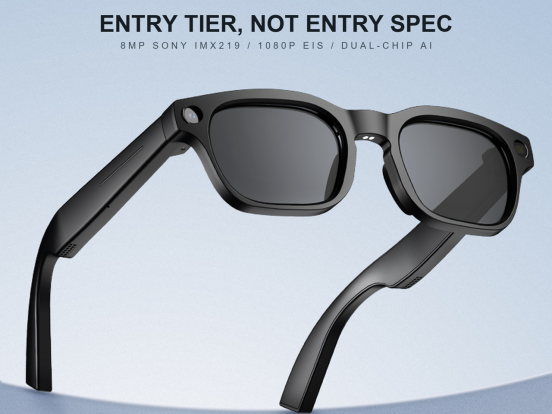
SC01: entry-tier positioning with a named 8MP Sony sensor, a dual-chip architecture and an optional charging case.
Section 1: Key Concepts Every Buyer Should Understand
What the entry tier actually is, in 2026
An entry-tier AI camera frame is not a stripped-down flagship. It is a different architecture: a single board carrying a Bluetooth system chip and a lighter application chip, a fixed-focus camera module, one or two microphones, and a speaker in the temple, running a real-time operating system rather than Android. The SC01 follows that pattern with a JL7018F6 as the Bluetooth and system chip and a TXW826-824 as the auxiliary chip, 2GB of storage as standard with a 4GB option, Bluetooth 5.3, Wi-Fi 4, and a quoted Bluetooth range of 10 to 15 metres.
That architecture is where the cost saving genuinely lives, and none of it is a compromise a buyer needs to fear. RTOS boots faster and idles lower than Android, the fixed-focus module removes an autofocus motor and its failure mode, and a two-chip split is cheaper than a single high-integration application processor. What you should refuse to accept at any price is an unnamed chipset, an unnamed sensor, or a resolution quoted only as an interpolated figure.
Where the cost actually goes, and what moves the price
A quotation for this product class is driven by six items: the camera module, the two chips and their memory, the battery, the frame and lens set, the charging case if it is included, and the packaging and documentation. Everything else is margin and volume. That is why a serious supplier quotes per project rather than publishing a single number: the same frame can ship with 2GB or 4GB of storage, three different lens colours, with or without the case, in a retail box or a polybag, and each choice moves the landed cost.
It is also why a published price on a website is usually a band with conditions attached rather than a figure. A number without its trade term, quantity break and accessory set is not a price, it is a starting point for a misunderstanding. When you compare quotations, ask each supplier to state the same four things on one page: trade term, quantity break, what is inside the box, and which specification lines are guaranteed per lot.
For buyers who want a public reference point before the first call, the practical approach is to publish a band rather than a price, marked as indicative and tied to a stated quantity and trade term, and to keep the exact number in the quotation. That keeps the page useful to a procurement team searching for a cost range without turning a 2026 figure into a 2028 negotiating position.
The camera decision: eight megapixels in, 1080P out
The SC01 uses a Sony IMX219 sensor with an eight megapixel lens, and outputs photos and video at 1920 by 1080, with video at 30 frames per second and a 12 minute limit per clip. Read that honestly: the sensor is eight megapixels, the delivered file is 1080P. For a first-person camera aimed at social content, short-form video and documentary capture, 1080P is the format the platforms actually consume, and it keeps the file small enough to transfer over Wi-Fi and to edit on a phone.
Stabilisation is electronic, applied through EIS rather than a mechanical gimbal, and that is the correct trade at this price point: a moving lens assembly would add cost, thickness and a wear item. The thing to test is whether EIS is applied to video as well as stills, because a supplier who stabilises only photos is selling you half of the feature. A single LED light sits next to the camera for fill in low light.
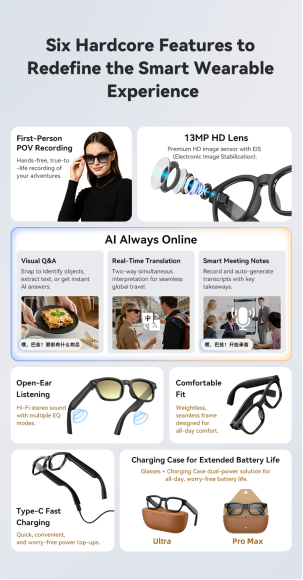
Six functions on one frame: first-person capture, EIS, visual Q&A, live translation, meeting notes and open-ear audio.
open-ear audio.
Battery, and why the case is an option rather than a bundle
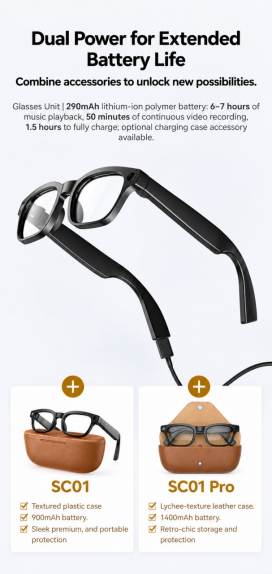
The frame carries a 290 mAh lithium polymer cell, quoted at 6 to 7 hours of music playback and 50 minutes of continuous recording, with a full charge in about 1.5 hours at roughly 200 mA. The optional charging case adds a 900 mAh cell and takes about 2 hours to charge itself, which is what turns a 50 minute recording budget into a working day away from a wall socket.
Making the case optional is a deliberate cost decision, and it is the one that lets an entry-tier product stay entry-tier. Distributors who sell into markets where a case is expected can take it; buyers who need the lowest possible unit cost for a promotional SKU can leave it out. Ask your supplier to quote both configurations on the same page, because the delta between them is the cleanest way to see whether the case is priced as hardware or as margin.
AI at entry level: cloud capability, local cost
The AI features on this class of product run in the cloud, which is what makes them affordable: the frame carries a microphone and a camera, and the reasoning happens on a server. The SC01 supports image recognition triggered by voice or by a button, conversational Q&A, simultaneous interpretation, dialogue translation and meeting summaries, with translation and interpretation handled through Microsoft services and meeting notes generated on a domestic model for the China build.
For international builds the platform selects between GPT, Grok and Gemini according to node speed, which is worth understanding before you promise a customer experience. It means the assistant your end user meets is the one their region can reach fastest, not a fixed model. Ask any supplier how the routing behaves when the preferred node is slow, and what the fallback is, because that answer decides whether the demo works on a Monday morning in your market.
Language coverage at this level is usually the strongest line on the sheet relative to cost: the SC01 app ships in 30 interface languages including English, Simplified and Traditional Chinese, Japanese, Korean, German, French, Spanish, Arabic, Russian, Italian, Portuguese, Ukrainian, Hindi, Polish, Greek, Vietnamese, Indonesian, Thai, Dutch, Turkish, Romanian, Danish, Swedish, Czech, Bengali, Persian, Hebrew, Malay and Slovak, and the translation engine covers those plus Slovenian, Hungarian, Lithuanian, Latvian, Estonian and Khmer. The wake words are "Hey, Baz" and "Hey, Buzz", and the companion app is Buzz-Tech.
Fit, materials and the honest numbers
The frame is PC, the temples are ABS plus PC, and the lens is PC, supplied in three optical versions: a clear anti-blue-light lens, a gradient brown lens and a gradient grey lens, across black, white and red shells. The frame measures 153 mm with 145 mm temples and weighs about 35.6 grams, which is what makes the product wearable for hours rather than minutes; the retail box measures 168 by 61 by 61 mm without the case.
Two aluminium buttons sit on the left temple and a touch strip on the right. The first button takes a photo, records video on a double press, answers or rejects calls, powers the frame off on a five-second hold and restores factory settings on a ten-second hold; the second wakes the assistant, takes and recognises an image on a double press, and starts audio recording on a two-second hold. The touch strip handles pause and play, track skipping and volume. Wear detection pauses playback when the frame comes off, and firmware updates arrive over the air.
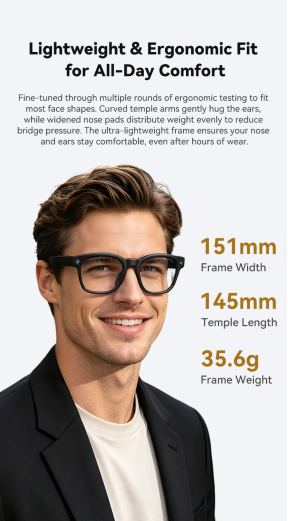
Frame width, temple length and weight as published for the SC01: 153 mm, 145 mm and about 35.6 g.
Section 2: How to Compare Suppliers, Criteria, Risk Points and Checklist
At entry level the comparison is not between products, it is between the honesty of two specification sheets. The table below lists what to demand line by line, why each line matters at this price point, and the pattern that usually means a number was invented for the page.
What to check | Why it matters | Red flag |
Sensor versus output | An 8MP IMX219 delivering 1080P photos and 1080P30 video is a real, verifiable pair of numbers. | Only one large number quoted, with no native output figure. |
Chipset names | JL7018F6 plus TXW826-824 tells you the architecture and where the processing limits sit. | Unnamed chips, or an architecture described only as 'dual core'. |
Stabilisation scope | EIS should apply to video as well as stills; test by walking while recording. | Stabilisation claimed only for photos, or jitter visible at walking pace. |
Recording time | 50 minutes of continuous recording and a 12 minute clip cap are the numbers that decide usability. | Run time quoted only as music playback hours. |
Battery and charging | 290 mAh in the frame, 1.5 hours to charge; the optional case adds 900 mAh and 2 hours. | Capacity quoted without charge time or charging current. |
Case as an option | Quoting with and without the case on one page shows you what the accessory actually costs. | One bundle only, with the case priced inside a single opaque number. |
Audio chain | 1012 speaker at 0.8 W with two silicon microphones and dual-microphone noise reduction. | Single microphone; call quality unusable outdoors. |
AI routing | Cloud assistant with a stated model selection policy and a fallback when the node is slow. | Model names listed without any routing or fallback explanation. |
Language coverage | 30 app languages and a translation list that names what it covers. | A round number with no language list. |
Frame and weight | PC frame, ABS plus PC temples, 153 mm across, 145 mm temples, about 35.6 g. | Weight omitted; frame material described only as 'metal-look'. |
Lens options | Clear anti-blue-light, gradient brown and gradient grey, across black, white and red. | A single lens and colour, with no roadmap for variants. |
App and OS support | Buzz-Tech app, RTOS firmware, Android 8.0 and above, iOS 13 and above, OTA updates. | App that only exists on one platform, or no OTA path. |
Packaging and manual | 168 x 61 x 61 mm box without the case, with documentation you can localise. | English-only manual; no carton dimensions. |
Ask every candidate for the same three artefacts: a sample you can keep for a week, a specification sheet that separates sensor from output and native from interpolated figures, and a written statement of which parameters are guaranteed per lot. Then test the three claims that cost the most to fix later: recording time, stabilisation in video, and microphone quality on a real call.
Questions worth putting in the first email, before price:
· Output figures. What resolution do photos and video actually leave the camera at, separately from the sensor specification?
· Stabilisation scope. Is EIS applied to video as well as stills, and can I see an unstabilised comparison clip?
· Case delta. What is the price difference between the frame alone and the frame with the charging case?
· Lot guarantee. Which specification lines are guaranteed per lot, and what is the tolerance on each?
· Repeat samples. Can you send two samples from different production lots for comparison?
Section 3: From Sampling to Bulk Order, How It Usually Works
1. Sampling
Start with one working sample and treat it as the reference standard. Record a ten minute walk with the frame, then play the footage back on a phone rather than on a monitor, because that is how the end user will see it. Time a full recording session against the quoted 50 minutes, test a call outdoors with the window open, and check how long a full charge actually takes. Photograph the lens colour against a fixed grey card so later shipments can be compared by image rather than memory.
2. Customisation and OEM/ODM
The SC01 ships as a PC frame with three lens options and three shell colours, so customisation sits around the product rather than inside it: brand and packaging artwork, the manual in your market's languages, the accessory set, retail box and carton printing, and the app branding conversation with your account manager. Storage is the one electronic option worth fixing early, since 2GB and 4GB are different part numbers, not a software setting.
3. Bulk production
Volume breaks, lead time and unit price are quoted per project and depend on storage, lens type, case inclusion and packaging, so they are confirmed in writing rather than published. Fix three things early: the approved sample, the packaging artwork and the manual text. Those decide how fast a run moves once the order is placed, and they are the three items that most often delay a first container.
4. Quality control and delivery
A practical inspection list for this class of product has five lines: camera output against a resolution chart in both photo and video modes, stabilisation on a walking clip, microphone and speaker check on a real call, battery run time against the approved sample, and a drop test on the packed retail box. Ask that the sampling photographs and the run-time record are kept with the lot records; comparing those against the shipment is the cheapest quality control available to you.
Section 4: Introducing the SC01 AI Camera Smart Glasses
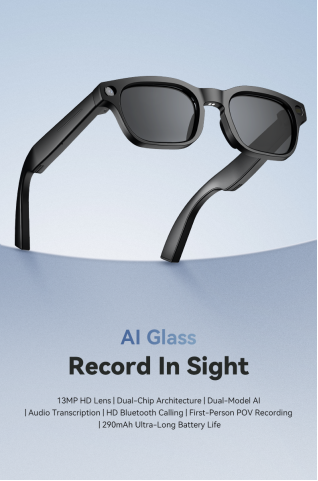
The SC01 frame: PC shell, glass camera window, aluminium buttons and a touch strip on the right temple.
1. A frame that does not look like a device
The SC01 is a thick-rim PC frame in black, white or red, with a glass camera window set into the top corner and two aluminium buttons built into the left temple. There is no screen, no light ring and no external module: from across a room it reads as a pair of acetate-style glasses, which is the point of the category and the reason it can be worn into places a camera would not be welcome.
2. Imaging you can verify
The camera is a Sony IMX219 with an eight megapixel lens, delivering 1920 by 1080 photos and 1080P video at 30 frames per second, with EIS stabilisation and a 12 minute cap on a single clip. Transfer runs over Wi-Fi, so footage reaches a phone without a cable, and a single LED light beside the camera gives fill when the light drops. These are modest numbers by flagship standards, and they are the right numbers at this price: they are all verifiable, and none of them depends on interpolation.
3. An assistant that runs in the cloud
Press the second button and the assistant wakes; say "Hey, Baz" or "Hey, Buzz" and it wakes hands-free. From there the frame recognises what the camera is pointed at, answers questions through the temples, translates a conversation in real time, or summarises a meeting. Interpretation and dialogue translation run on Microsoft services, meeting summaries are generated on a domestic model for the China build, and international builds select between GPT, Grok and Gemini by node speed. The Buzz-Tech app carries settings, gallery transfer, custom audio effects and firmware updates, and it ships in 30 interface languages.
4. Sound, storage and everyday controls
Audio comes through a 1012 AAC high-fidelity speaker quoted at 0.8 W, with two surface-mount silicon microphones running dual-microphone noise reduction, so a call in a street or a car is still intelligible to the other side. Storage is 2GB as standard with a 4GB option, enough for a day of short clips before offloading. Pause and play, track skipping and volume sit on the right-hand touch strip, while photo, video, calls, power and factory reset live on the two left-temple buttons, and wear detection pauses playback when the frame comes off.
5. Battery, case and what ships in the box
A 290 mAh cell gives about 6 to 7 hours of music playback or 50 minutes of recording, and charges in about 1.5 hours over Type-C. The optional textured plastic case carries 900 mAh and takes about 2 hours to charge itself, so the pair covers a full day away from a socket. The box measures 168 by 61 by 61 mm without the case, holds the frame, the cable and the documentation, and can be localised for your market.
Built for your brand
SC01 is positioned for private-label and OEM programmes where the unit cost has to hold: the sensor, chipset and frame stay fixed so the product keeps its identity and its test basis, while storage, lens type, case inclusion, packaging and documentation are matched to your market and channel. If your roadmap needs a different lens or a different accessory set, that conversation belongs at the sampling stage, before artwork is approved.
FAQ (Buyer's Quick Reference)
A Sony IMX219 sensor with an eight megapixel lens, 1920 by 1080 photos, 1080P video at 30 frames per second, EIS stabilisation, a 12 minute limit per clip, Wi-Fi transfer and one LED fill light.What camera and video specifications does the SC01 carry?
About 6 to 7 hours of music playback or 50 minutes of continuous recording from a 290 mAh cell, charged over Type-C in about 1.5 hours. The optional 900 mAh case takes about 2 hours to charge itself.How long does it run, and how is it charged?
It is an option. The frame can be ordered alone for the lowest unit cost, or with the 900 mAh textured plastic case where a full-day battery is expected in the channel.Is the charging case included?
Capture, calls, music and voice wake-up run on the frame. Recognition, translation and meeting summaries need the paired phone and a data connection, because the reasoning runs in the cloud.Which AI functions work without a phone?
The Buzz-Tech app ships in 30 interface languages, and the translation engine covers those plus Slovenian, Hungarian, Lithuanian, Latvian, Estonian and Khmer.Which languages are supported?
These are quoted per project. Because storage, lens type, case inclusion and packaging all move the cost, we quote a band against a stated quantity and trade term rather than publishing a single figure.What about price, MOQ and lead time?
Let's Discuss Your Project
If you are building an entry-tier AI camera programme for a 2026 or 2027 launch, the fastest way to a useful answer is to send your target retail price point, estimated quantity, destination market and the accessory set you plan to offer. With those four inputs we can tell you which configuration fits the price you need to hit, which lines can be held and which should be left flexible, and arrange a sample you can test against the numbers on this page.
Tell us what your customers will actually do with the product, how long their days are, and what they are willing to pay for it, and the specification stops being a table of numbers and becomes a business case.
Contact us
Send your requirement to the contact below, and please include target quantity, destination market and the accessory set you plan to offer so we can reply with the right configuration and a quotation on the same page.
Website: www.szmorrison.com
Email: sales06@szmorrison.com
WhatsApp: +86 17318011665

Quick Links
Contact us
Categories