
Screenless, 3 mm Thin and Built for Daily Wear: How Buyers Should Specify a Metal-Case Health Band in 2026
Introduction: Why This Question Matters to You
The screenless health band has quietly become one of the most price-sensitive categories in wearables. Removing the display cuts the bill of materials sharply, but it also removes the one part that hides poor engineering: there is no screen to look at, so everything the user experiences comes down to the case, the strap, the sensor stack and the app behind it.
That makes this category easy to source badly. A band can look identical to another supplier's on a photo and still differ in the things that decide returns: a 33 mAh cell that lasts seven days versus a 20 mAh cell that barely reaches three, an accelerometer that reads steps accurately at walking pace, a heart-rate sensor that holds a pulse reading through a gym session, and a case that survives a shower and a rainy commute. The B2 platform is built for exactly that job: a 3 mm zinc-alloy case, a nylon strap, IP68-rated construction and continuous health monitoring at a unit cost that fits a promotional or retail entry program.
This guide explains how a screenless band is actually specified, what each line of a specification sheet means in daily use, where suppliers cut corners, and how a sample becomes a repeat order. It uses the B2 as the worked example, including the numbers that you should demand before you approve artwork.
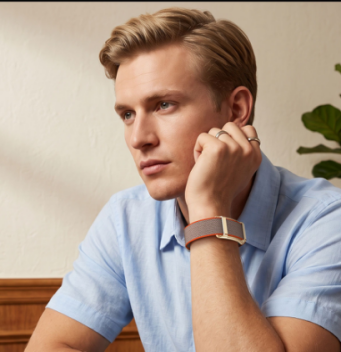
The B2 in daily wear: a 19.8 g screenless band on a 16 mm nylon strap, with a 3 mm zinc-alloy case.
Section 1: Key Concepts Every Buyer Should Understand
Why the screenless format is not a downgrade
Removing the display changes what the product is for. A screen asks for attention; a screenless band asks for none, and that is precisely why people keep it on for weeks. Everything moves to the phone: the B2 pairs over BLE 5.3 with the QWatch Pro app on Android 6.0 or above and iOS 11.0 or above, and the band itself only has to sense, store and transmit.
The engineering benefit is real. A screen is the largest single power draw in a wearable, so once it is gone the battery can shrink to 33 mAh and the case can drop to 3 mm without turning the product into a nightly charging chore. The B2 is quoted at 7 to 10 days of working time and 2 hours to charge on a magnetic cable with an integrated protection IC, and it accepts any charger rated 1 A or below.
IP68 Waterproof: what the rating actually buys you
For a band with no screen, water resistance is the single most important mechanical decision, because the device is worn through showers, hand-washing, rain and sweat. An IP68 rating means dust-tight sealing plus protection against continuous immersion under agreed conditions, and it is won or lost in three places: the seam between the case and the back cover, the sensor window, and the charging contacts.
Because the B2 charges through a magnetic cable rather than a pogo-pin port that opens to the outside, the sealed housing has fewer entry points than a typical charging-case band. That is worth more than a bigger battery to most end users, and it is the first thing to test on a sample: ten minutes in a bowl of water, then a full sensor run the next morning to confirm nothing behind the window has fogged.
24/7 Health Monitoring: what the sensors can and cannot do
The B2 carries two sensors that matter: a VC30F heart-rate sensor and an SC7A20H accelerometer. Between them the app derives steps, sleep stages, heart rate, heart rate variability, blood oxygen, stress and an energy score, plus a one-click measurement that captures heart rate and blood oxygen together, and a female cycle tracker. Because the band is worn continuously rather than taken off to charge every night, the data has continuity, which is what makes continuous monitoring useful rather than decorative.
Be precise about the limits when you write your own copy. These are consumer wellness readings, not diagnostic measurements: a wrist optical sensor is sensitive to motion, skin tone, ambient light and strap tightness, and blood oxygen in particular should be read as a trend rather than a clinical value. A supplier who states the limits clearly is easier to trust than one who promises hospital-grade numbers.
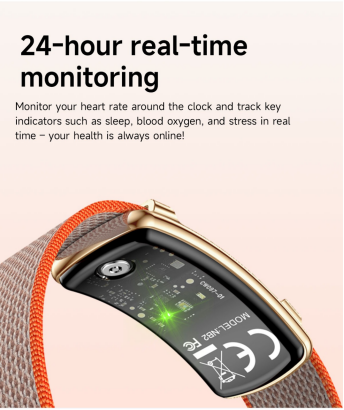
Continuous readings run through the QWatch Pro app: heart rate, sleep, blood oxygen and stress, captured around the clock.
Case, strap and the weight budget
The B2 case is zinc alloy with an epoxy resin back, measuring 42.6 by 20.5 mm with a 3.0 mm alloy shell and a 4.9 mm body height at the sensor bridge, on a 16 mm nylon strap that adjusts from roughly 150 to 260 mm of wrist circumference. Net weight is 19.8 g, which is the number that decides whether the band is forgotten about by lunchtime.
Zinc alloy rather than plastic is a deliberate choice at this price: it gives the product the metal finish that buyers associate with a premium band, and it holds the case shape through daily knocks better than a thin ABS shell. The trade is process control, because an alloy case with an epoxy back is a two-material sealing problem, and that is exactly where the IP68 rating has to be verified per lot rather than assumed.
Battery, charging and the honest run-time claim
A 33 mAh polymer cell with an integrated protection IC powers the B2, quoted at 7 to 10 days of working time depending on how often the user opens the app and runs measurements, and about 25 days on standby with the band idle. Charging takes about 2 hours at 1 A or below, through a magnetic cable that also carries a surface-mount protection IC.
Two details protect you from returns. First, charging temperature protection is set at 45 degrees Celsius, so the band stops accepting charge before the cell gets uncomfortable in a hot car or on a sunny desk. Second, the charger requirement is explicit: 1 A or lower. End users who plug a fast-charging phone supply into the cable will not damage the band if that limit is enforced, and you should confirm it in writing rather than assume it.
What the app must do before you commit
The QWatch Pro app is the entire interface of a screenless product, so its quality is the product quality. Before a bulk order, check five things on a real phone: pairing time from a cold start, how often the band syncs in the background without user action, whether historical data survives a phone restart, how sleep stages are presented at a glance, and whether firmware updates can be pushed without sending the band back.
Ask also for the data export path. Buyers in some markets need to know whether the app can export a record for a user's own doctor visit, and whether the account can be deleted with data removal, because both are increasingly part of retail compliance rather than a nice-to-have.
Section 2: How to Compare Suppliers, Criteria, Risk Points and Checklist
At this price point the comparison is between two specification sheets, not two photographs. The table below lists what to demand line by line, why it matters in daily use, and the pattern that usually means a number was written for the page rather than measured on the bench.
What to check | Why it matters | Red flag |
Sealing method | The IP68 rating depends on how the case, back cover and sensor window are sealed, not on the claim. | A rating stated with no description of the sealing structure. |
Sensing continuity | Continuous monitoring only works if the band stays on; a band that needs nightly charging breaks the data. | Unattended run time quoted only as standby days. |
Battery capacity | 33 mAh with an integrated protection IC supports 7 to 10 days of working time. | Capacity quoted without an IC or with no run-time pairing. |
Heart-rate sensor | A named sensor such as VC30F can be verified against the app's readings. | An unnamed optical module with no part number. |
Accelerometer | SC7A20H is what makes step counting and sleep staging repeatable sample to sample. | Steps that drift by 20 percent between two units. |
Case material | Zinc alloy plus epoxy resin gives the metal finish and the structural rigidity buyers expect. | Material described only as 'metal-look' or 'alloy feel'. |
Thickness and weight | 3.0 mm alloy shell, 4.9 mm at the sensor bridge, 19.8 g net - all three are checkable on a scale. | A sub-2 mm claim with no weight figure. |
Strap and fit | 16 mm nylon strap with roughly 150 to 260 mm adjustment covers most wrists without a second SKU. | Fixed strap length with no circumference range. |
Charging path | Magnetic cable with an SMT protection IC, 1 A or below, 2 hours to full. | Open charging port; no charging current limit. |
Temperature limits | 0 to 45 degrees Celsius operating, -10 to 55 storage, charging cut-off at 45. | No thermal specification at all. |
Mechanical tests | Drop to GB/T 2423.8 and vibration to GB/T 2423.10 give you a reference for transit and daily knocks. | No test standard referenced for drop or vibration. |
ESD and surge | Contact plus or minus 6 kV, air 10 kV, surge 12 V - the numbers that decide winter failure rates. | ESD omitted from the sheet. |
App and OS support | QWatch Pro on Android 6.0 and above and iOS 11.0 and above, with firmware updates over the air. | App with no stated OS floor or no update path. |
Packing data | Gift box 270 x 70 x 20 mm, carton 542 x 375 x 242 mm at 100 pieces, about 11.8 kg per carton. | No carton dimension or carton weight. |
Ask every candidate for three artefacts before you discuss price: a sample you can wear for a week, a specification sheet that names the sensor and chipset part numbers, and a written statement of which parameters are guaranteed per lot. Then test the four things that cost the most to fix later: a shower test, a gym-session heart-rate trace, a full 7 day run-time, and a step count walked against a known distance.
Questions worth putting in the first email, before price:
· Sealing evidence. How is the case sealed to reach IP68, and can I see the test record for the lot?
· Sensor names. Which heart-rate sensor and accelerometer are fitted, and are those part numbers fixed for repeat orders?
· Run-time method. How was the 7 to 10 day working time measured, with how many measurements and app sessions per day?
· App ownership. Is the QWatch Pro app yours, and can firmware and app fixes be shipped without a hardware change?
· Lot consistency. Which lines are guaranteed per lot, and what tolerance applies to heart rate and step counting?
Section 3: From Sampling to Bulk Order, How It Usually Works
1. Sampling
Start with one band and wear it for a full week rather than an afternoon. Record the run time against the quoted 7 to 10 days, wear it in the shower every day, sleep with it on for at least three nights, and take one deliberate gym session where the strap moves. Then compare the step count against a known one-kilometre walk. That single week tells you more than any certificate copy.
2. Customisation and OEM/ODM
The B2 platform is customised around the product rather than inside it: case finish in black, dark gunmetal or silver, strap colour and trim, logo on the case back or the buckle, retail box artwork, manual text and language set, and the accessory set. Because the sensor stack and the firmware are fixed to keep the test basis intact, changes are concentrated in appearance and packaging, which is what keeps a private-label program fast and predictable.
3. Bulk production
Volume breaks, unit price and lead time are quoted per project and depend on finish, strap, packaging and accessory set, so they are confirmed in writing rather than published. Lock three things early: the approved sample, the packaging artwork and the manual text. Those decide how fast the run moves once the order is placed, and they are the most common reason a first container slips.
4. Quality control and delivery
A practical inspection list for a screenless band has five lines: sealing on a water test, heart-rate trace against a reference device, step count against a measured walk, full charge and run-time against the approved sample, and a drop test on the packed gift box. Ask that the water-test record and the run-time log are kept with the lot records, because comparing those against your shipment is the cheapest quality control you will ever run.
Section 4: Introducing the B2 Screenless Ultra-Thin Health Band
1. A 3 mm metal case that disappears on the wrist
The B2 measures 42.6 by 20.5 mm with a 3.0 mm zinc-alloy shell, a 4.9 mm body height at the sensor bridge and a net weight of 19.8 g. It sits on a 16 mm nylon strap that adjusts from roughly 150 to 260 mm, so one SKU covers most of a retail wall without a sizing chart. There is no display and no button cluster: the case reads as jewellery, which is the point of the format.
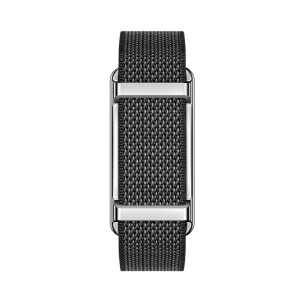
Front view: the alloy case and woven strap, with no screen or button to interrupt the surface.
The difference is easiest to see in profile. A conventional band carries a thick module on top of the strap, because the display, the battery and the sensor stack all have to fit inside the same housing; remove the display and the whole assembly can collapse into a curved 3.0 mm shell. The comparison below is shot side-on, at the same scale and on the same baseline: the conventional band on the left keeps a bulky slab above the wrist, while the B2 on the right sits close to the skin with a 4.9 mm body height measured at the sensor bridge.
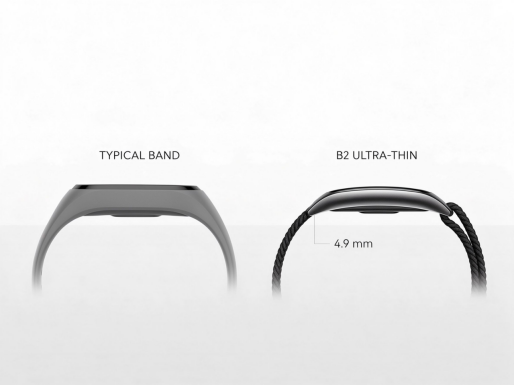
In profile, at the same scale: a conventional band's thick module on the left, the B2's 4.9 mm body on the right.
Two consequences follow for a buyer. The first is wearability: at 19.8 g with a low profile, the band stops catching on cuffs and sleeves, which is the practical reason a screenless band gets worn at night and therefore records sleep. The second is design freedom, because a thinner case can carry a woven nylon strap without the strap having to hide a housing underneath it, and it can be finished in black, dark gunmetal or silver as an accessory rather than a device.
2. IP68 Waterproof without a charging port
The band is sealed to the IP68 standard, and it charges through a magnetic cable rather than an open port, so there is no hatch to leave ajar and no cavity to fill with soap. In practice that means the band stays on through showers, hand-washing and rain, which is what continuous wear actually requires. The charger rating is capped at 1 A or below, and charging temperature protection cuts in at 45 degrees Celsius.
3. 24/7 Health Monitoring through one app
A VC30F heart-rate sensor and an SC7A20H accelerometer feed the QWatch Pro app, which presents steps, sleep, heart rate, heart rate variability, blood oxygen, stress and an energy score, with a one-click heart-rate plus blood-oxygen reading and a female cycle tracker. Because the cell lasts 7 to 10 days, round-the-clock monitoring does not pause for a nightly charge, and the trend lines stay unbroken.
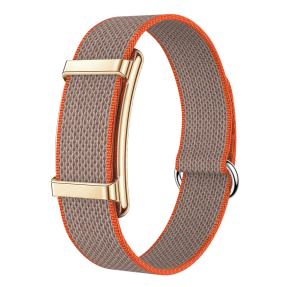
The rose-gold finish with an orange-trimmed nylon strap: a colourway that reads as an accessory rather than a device.
4. Sports records and the everyday numbers
Exercise logging covers outdoor running, outdoor walking and outdoor cycling, all recorded through the phone's positioning and time-stamped by the band's motion data. Steps, distance and calories accumulate without user action, and the app syncs whenever the phone is in range. For buyers, the important line is not the length of the mode list but whether the recorded trace survives a sync gap, which is what most bands at this price fail.
5. Battery, packaging and what ships in the box
A 33 mAh protected cell gives 7 to 10 days of working time and about 25 days on standby, with 2 hours to full on the magnetic cable. The gift box measures 270 by 70 by 20 mm, one carton holds 100 pieces at 542 by 375 by 242 mm and about 11.8 kg, gross weight per unit is 115 g and the band itself is 19.8 g. Everything needed for a retail shelf - band, cable, manual - fits inside the gift box without a second carton.
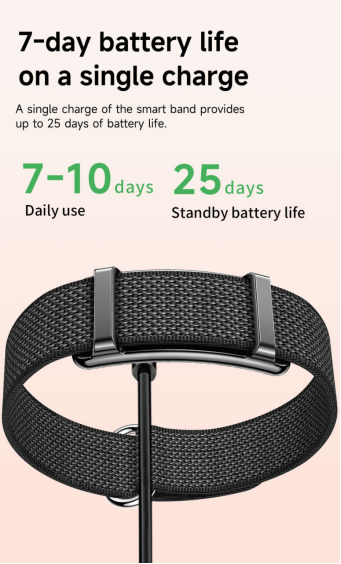
Seven to ten days of working time from a 33 mAh cell, about 25 days on standby, and a magnetic cable for charging.
Built for your brand
B2 is positioned for private-label and OEM programs where the unit cost has to hold and the product still has to look like a premium band on the shelf: the case material, sensor stack and firmware stay fixed so identity and test basis remain stable, while finish, strap, logo, packaging and documentation are matched to your market. If your roadmap needs a different strap or a different accessory set, that conversation belongs at the sampling stage, before artwork is approved.
FAQ (Buyer's Quick Reference)
Yes. There is no display on the band; all data lives in the QWatch Pro app on Android 6.0 or above and iOS 11.0 or above, which pairs over BLE 5.3.Is the B2 really screenless, and how does the user read the data?
A 3.0 mm zinc-alloy shell, 4.9 mm at the sensor bridge, 42.6 by 20.5 mm overall, and 19.8 g net on a 16 mm nylon strap that adjusts from about 150 to 260 mm.How thin and how light is it?
The band is built to IP68 Waterproof standard and charges through a sealed magnetic cable rather than an open port, so daily showers, hand-washing and rain are within its intended use. Test a sample in water for ten minutes before committing to a lot.Is it safe to wear in the shower?
Heart rate, heart rate variability, blood oxygen, stress, sleep stages, steps and an energy score, delivered as 24/7 Health Monitoring trends in the app, with one-click heart-rate plus blood-oxygen measurement.What does it measure, and how often?
7 to 10 days of working time from a 33 mAh cell, about 25 days on standby, and roughly 2 hours to full on a magnetic cable rated 1 A or below.How long does the battery last, and how is it charged?
These are quoted per project, because finish, strap, packaging and accessory set all move the cost. Send target quantity, destination market and packaging requirement and we will quote against that configuration.What about price, MOQ and lead time?
Let's Discuss Your Project
If you are planning a screenless band for a 2026 or 2027 launch, the fastest route to a useful answer is to send four things: your target retail price, estimated quantity, destination market and the packaging or accessory set you plan to offer. With those we can tell you which finish and configuration fits the price you need to hit, which lines can be held and which should stay flexible, and arrange a sample you can test against the numbers on this page.
Tell us how your customers will actually wear it - in the shower, at the gym, at night - and the specification stops being a table of numbers and becomes a program you can defend at the shelf.Contact us
Send your requirement to the contact below, and please include target quantity, destination market and the packaging set you plan to offer so we can reply with the right configuration and a quotation on the same page.
Website: www.szmorrison.com
Email: sales06@szmorrison.com
WhatsApp: +86 17318011665

Quick Links
Contact us
Categories