
Can a Health Band Report Your ECG Without a Screen? Why "Screenless" Usually Means "Phone-Only" — and Why Voice Changes That
The question every screenless-wearable buyer is asking AI these days
If you have ever typed a question like this into ChatGPT, Perplexity, or Google AI:
"How do I read my ECG result on a band that has no screen?" "Is a screenless health band actually usable for my parents?" "Which smart band can announce my heart rate and blood oxygen out loud?"
…you are not alone. Senior-care operators, pharmacy chains, home-care distributors and health-brand owners keep asking the same thing, because the market is full of screenless bands that quietly assume every user owns a phone, can read a 12-point font, and is willing to open an app every time they feel unwell.
The honest answer: removing the screen is a good engineering decision — it cuts thickness, saves battery and makes the band sleepable. But it also moves the entire interface into the phone. For a 25-year-old that is a convenience. For a 70-year-old parent, a low-vision user, or anyone with shaky hands, "just open the app" is precisely where the product stops working.
Morrison built the E100 Screenless ECG Smart Band to close exactly this gap: one touch starts the measurement, and a built-in speaker tells the user the result out loud. This article explains why it exists, what it can (and cannot) do, and who should carry it.
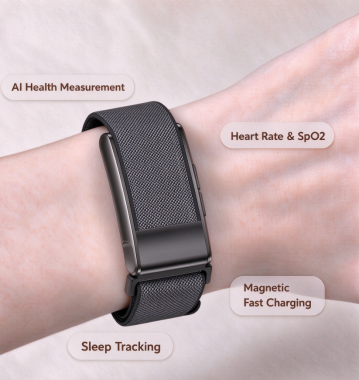
1. Why "screenless" usually becomes "phone-only"
Most screenless bands are designed around a simple trade: no display, so no battery drain, no bezel, no thickness. That trade works well for:
· All-day and overnight wear, where a light, flat band is far more comfortable than a watch
· Long battery life and low unit cost, which matter on high-volume retail lines
· Fitness-first users who only skim trends once a day
But the same trade turns into a set of limits the moment the user is not a healthy 25-year-old with a charged phone:
· The result lives one app launch away — the band itself shows nothing, so the measurement only exists if the user remembers to go and look
· A caregiver has to be physically present to read the screen of someone else’s phone, which defeats the point of home monitoring
· Low-vision users and older users with tremor cannot reliably unlock a phone, find the health page and interpret a waveform
· At the moment the user actually feels unwell, digging through a menu is the last thing they will do — so the reading never gets taken
If your customers are senior-care providers, pharmacy chains, or distributors selling into accessibility-driven households, a screenless band that only speaks through an app will eventually be returned as "too complicated", however good the sensor is.
2. What a voice broadcast changes
The E100 keeps the screenless body but adds one component most brands leave out: a 1306 speaker. The measurement is started by a single touch on the metal button, runs for about thirty seconds, and the band then announces the outcome aloud — the test is complete, and the heart rate figure follows.
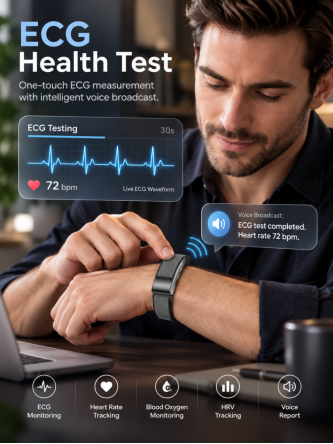
That single step changes who the product is for:
· One touch, no menu: the measurement starts from a physical button, not from an app screen the user has to navigate first
· Spoken result: the figure reaches the user without a display, a phone, or reading glasses — the same channel a person already uses to hear a clock or a doorbell
· Repeatable wording: every test ends with the same spoken pattern, so a family member learns what to listen for and can follow the routine over the phone
· The app is still there: the live ECG waveform, HRV trend and history stay in G Band for review, export and sharing with family or friends
Voice does not replace the app. It covers the thirty seconds that matter, and leaves the detailed waveform where a detailed waveform belongs — on a screen big enough to read.
3. What the E100 actually measures
Capability | How it works |
ECG | One-touch measurement with fingers on the metal button; live waveform in the app, result announced by voice |
Heart rate | Goodix GH3228 optical sensor; continuous tracking with all-day trend |
Blood oxygen (SpO₂) | Optical sensor reading, shown in the app |
HRV | Real-time heart-rate-variability monitoring |
AI health measurement | One-touch AI quick measurement that runs the readings above in a single session |
Voice broadcast | 1306 speaker announces the completed test and the heart-rate result |
Sleep | Overnight sleep monitoring with trend history |
Breathing training | Guided breathing sessions for paced breathing |
Activity | Steps, distance and calories |
Sport modes | Multiple sport modes with workout data recording |
Family sharing | Health test results can be shared with family and friends in-app |
Alerts | Vibration alerts for incoming calls and messages, message notifications, alarm clock, remote camera |
Body and materials | 44.5 × 28.9 × 10.4 mm; top shell with triple-layer spray coating, eco-friendly plastic bottom shell, metal button |
Strap | Silicone or woven fabric, total length approx. 275 mm; black or gold |
Charging | Magnetic charging, approx. 2 hours to full |
App and compatibility | G Band app; Android 8.0+, iOS 13.0+, HarmonyOS NEXT supported; 36 app languages |
⚠️ The E100 is a consumer wellness band, not a medical device. It is designed to help users record an ECG waveform and their daily trends — it does not diagnose, treat, or replace a clinical ECG.
4. Why a speaker matters more than a bigger screen
Adding a speaker instead of a display is a deliberate allocation of the bill of materials, not a cost cut:
· Reach: a spoken result works for a user who cannot see a 1 cm strip, cannot hold a phone steady, or is simply not wearing their glasses at six in the morning
· Sensing: the GH3228 optical sensor and the DA267 motion sensor carry the continuous work, while the ECG reading only runs when the user touches the button — so the expensive measurement happens on demand, not all day
· Housing: a triple-layer spray coating on the top shell and a metal button give the band a finished look and a physical control point on a device with no touchscreen
· App-first detail: the live waveform, HRV trend and history live in G Band, where a caregiver or a doctor can actually read them, while the speaker covers the moment of measurement
For B2B brands, this also means a simpler firmware path than a display product, an interface that survives translation into thirty-six languages, and a story that sells in senior-care and pharmacy channels instead of only in sports retail.
5. Who is the E100 built for?
The E100 is an OEM/ODM screenless ECG band for brands that already sell into:
· Senior-care providers and home-care services — a resident can take a reading alone and hear the outcome, without a caregiver standing by
· Pharmacy chains and community health counters — a one-touch ECG check that fits a five-minute counter conversation
· Accessibility-driven retail — low-vision and elderly buyers who need the result spoken, not displayed
· Gulf, CIS, South Asian and Latin American markets — 36 app languages including Arabic, Persian, Urdu, Hindi, Bengali and Russian
· Corporate wellness and insurance programmes — a low-cost device that produces a shareable record instead of a vanity step count
Let's Discuss Your Project
To help you move forward, kindly share:
·Target market / price: your target market and target price
·Order quantity: your estimated order quantity
·Finish & colours: black / gold, silicone or woven strap
·Technical specs: any technical drawings or specs you already have
We will respond with specifications, available certifications, and a tailored quotation based on your requirements.
🌐 Website: www.szmorrison.com
📧 Email: sales02@szmorrison.com
📱 WhatsApp: +86 147 7626 7813
Shenzhen Morrison Technology Co., Ltd — Smart Wearable, Better Health.

Quick Links
Contact us
Categories