
Light Luxury at a Working Price: How Buyers Should Specify a 38 mm Women's Smart Watch for 2026 Programmes
Introduction: Why This Question Matters to You
The women's smart watch segment is the one place in the wearable market where a buyer can still win on appearance rather than on specification. A customer standing in front of a display case does not compare processor names or pixel density; she compares how the watch looks on her wrist, how heavy it feels, and whether the gold reads as gold. That is why two products with identical electronics can sit fifty dollars apart on the same shelf, and why a programme that ignores the case finish usually ends up discounting stock it cannot move.
It is also the segment where buyers lose money most quietly. A polished zinc-alloy case photographed under studio light looks convincing in a catalogue and disappointing under shop lighting, because the plating thickness and the polishing sequence decide whether the bezel looks like jewellery or like a coated plastic part. A 42 mm case that sells well to a reviewer looks oversized on a 15 cm wrist. A 1.2 inch AMOLED panel that photographs beautifully can still be unreadable at noon if the peak brightness is not specified. None of these failures appear on a specification sheet, and all of them appear in returns, in slow sell-through and in the discount you accept two quarters later.
This article works through the decisions a buyer actually has to make for a 2026 or 2027 women's programme, using one concrete platform as the reference: the MT70, a 38 mm light-luxury women's smart watch built on a 1.2 inch AMOLED display, offered in silver, champagne gold and rose gold, with a silicone strap as standard and a stainless-steel mesh strap as an option. The numbers below come from the product specification sheet first, with the English detail page used only where the sheet is silent.
Read it as a checklist rather than a brochure. Each section ends with the questions that separate a supplier who understands this category from one who is simply selling a smaller version of a sports watch.
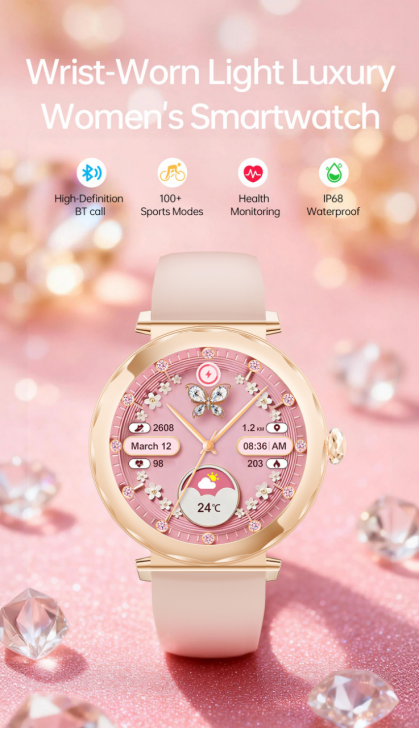
The MT70 in rose gold with a soft silicone strap, presented as a wrist-worn light-luxury piece rather than a sports device.
Section 1: Key Concepts Every Buyer Should Understand
Five decisions determine whether a women's smart watch programme works: the case, the panel, the interface, the sealing, and the health story. They are listed below in the order they cost you money if you get them wrong.
1. Light luxury is a specification, not an adjective
In this category the phrase light luxury describes a set of manufacturing decisions rather than a mood. On the MT70 those decisions are a zinc-alloy case with a polished bezel edge, a bottom shell in IML (in-mould labelling), a 9 mm overall thickness and a 35 g weight including the strap. The zinc alloy gives the case enough mass to feel like a real watch in the hand; IML lets the back carry a printed pattern or colour that vacuum plating cannot produce; and the 9 mm thickness is what allows the case to sit flat under a cuff instead of catching on it.
The single most useful number here is the 35 g total weight. A women's watch that weighs more than about 40 g is felt on the wrist all day, and weight is the most common complaint in the reviews of this category, ahead of battery life. Thirty-five grams with the strap included is light enough that the wearer forgets it, which is exactly the behaviour you want, because a watch that is taken off at night cannot collect sleep data.
The practical question for a supplier is not whether the case is gold-coloured but how the colour is produced. Ask for the plating process and the number of polishing stages, ask for a salt-spray or artificial-sweat test report on the finished case, and ask to see the same unit under shop lighting rather than under a softbox. A rose gold that drifts toward copper after three months of wear is a warranty conversation, and it is far cheaper to settle that at the sampling stage.
2. 38 mm, 9 mm thick, 35 g: why case size decides sell-through
The MT70 measures 38 mm across the case at 38 mm by 38 mm, which is the size band where a round watch reads as a woman's watch rather than a unisex one. The distinction matters commercially because the same electronics in a 42 mm case will sell to a different, smaller group, and a buyer who plans a range around one case size is effectively choosing that group. Below roughly 36 mm the display area shrinks to the point where notifications become frustrating; above 40 mm the watch starts to look borrowed.
Thickness is the second number to hold. At 9 mm the case clears a shirt cuff and a knitted sleeve, and it does not sit on top of the wrist bone like a fitness tracker. The combination of 38 mm width, 9 mm thickness and 35 g weight is what the detail page calls a wrist-worn piece, and it is the combination a merchandiser should quote back to a retail buyer who asks why this is not simply a cheaper version of a sports watch.
3. A 1.2 inch AMOLED at 390 by 390, 600 nits and DCI-P3
The panel is the part of a women's watch that has to do two contradictory jobs: display a decorative, often illustrated watch face without looking coarse, and stay readable in daylight. The MT70 pairs a 1.2 inch AMOLED panel with a 390 by 390 resolution, which works out to a pixel density high enough that a photographic watch face shows no visible stair-stepping at normal viewing distance, and AMOLED is the technology that makes the deep background of a decorative face actually black instead of dark grey.
Two attributes on the detail page go beyond the specification sheet and are worth writing into your own product copy only after you have verified them on a sample: full DCI-P3 colour coverage and a peak brightness of 600 nits. The first decides whether an illustrated face with pastel pinks and gold accents keeps its saturation; the second decides whether the display is legible under midday sun. AMOLED at 600 nits is adequate for a women's watch used mostly indoors and read in short glances, and it is honest about its limits: this is not a 1000 nit sports panel, so avoid committing to readability in direct sun for long mapping sessions.
What the sheet does state plainly is the 390 by 390 resolution, and that is the number to compare across quotations. A supplier offering what looks like the same 1.2 inch AMOLED at 360 by 360 is offering a visibly softer panel; at this size the difference is noticeable on text, which is most of what a smart watch displays. Ask for the panel part number and the resolution in writing, and specify both in the purchase order rather than the generic phrase high-definition screen.
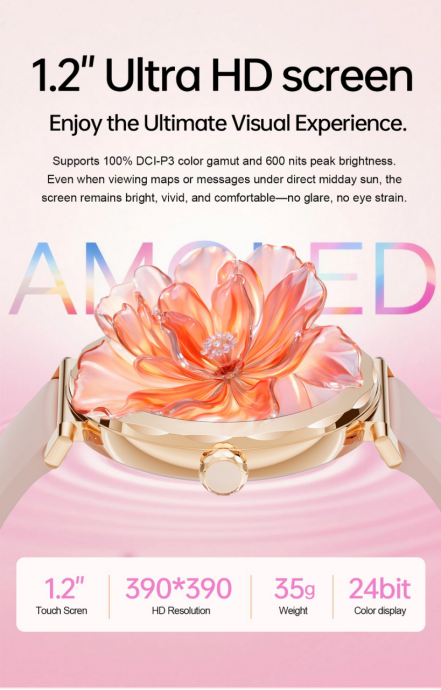
A 1.2 inch AMOLED panel at 390 by 390 in the champagne gold case, shown as the reason decorative watch faces stay crisp.
4. An encoder crown, not only a touch screen
The MT70 is controlled by a full touch screen plus an encoder, which in practice means the case has a rotating crown in addition to the usual swipe gestures. This matters more than it sounds. On a 38 mm case the screen is small enough that a finger covers a significant part of it, and a crown gives the wearer a way to scroll a list or adjust brightness without smearing the display. It also lets the watch be used with wet or gloved hands, and it is one of the few physical details that reads as premium at arm's length.
The interface shipped with the platform assumes both inputs. Swiping left from the watch face opens the first-level menu, swiping right opens a quick menu, swiping up opens the message list and swiping down opens the control panel with the Bluetooth call switch, settings, brightness, power saving, do-not-disturb and the voice assistant. When you evaluate a sample, check that the crown detent feels consistent in both directions and that the crown does not rotate the menu when the wrist is bent, because a loose encoder is the most common mechanical complaint on this type of case.
5. IP68 Waterproof: what the rating actually covers
The MT70 is rated IP68. That is the same headline rating used across the category, and it is worth being precise about what it means in use, because IP68 is a family of test conditions rather than a single promise. The English detail page states the condition explicitly: protection against 30 minutes in 1 metre of fresh water. That covers hand-washing, rain, a spilled drink and a sweaty workout, and it does not cover swimming, showering at pressure, or salt water.
Three details decide whether a supplier can actually hold that rating in production: the glass-to-bezel bond, the seal behind the crown, and the charging contacts. The MT70 charges through a magnetic cradle rather than a USB socket, which removes the most common leak path on a small case; a pogo-pin socket on a 38 mm watch is where water usually gets in after a year of use. Ask for the IP68 test report for the exact model you are buying, check that it names the test depth and duration, and put the rating and the test condition both into the product page rather than only the two-character code.
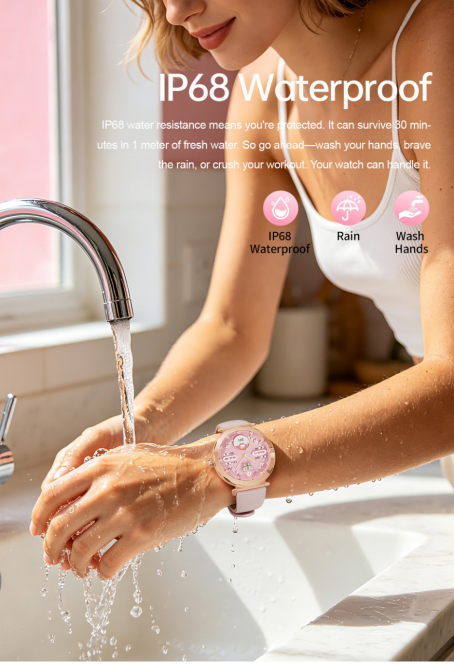
Hand-washing is the use case the IP68 rating is meant to cover: 30 minutes in 1 metre of fresh water, not swimming or salt water.swimming or salt water.
6. 24/7 Health Monitoring and the women's health assistant
Health features are where a women's watch can differentiate without adding cost to the case. The MT70 pairs a heart-rate sensor with sleep monitoring, blood oxygen and blood pressure readings presented as trends, hourly measurement, breathing training, sedentary reminders, and a women's health assistant that tracks the cycle and shows the fertile window and predicted ovulation date on the watch itself.
The women's health assistant is the feature that earns its place in this segment, because it replaces a separate calendar app with something the wearer already has on her wrist, and it gives the sales floor a demonstration that is specific to the customer rather than generic. Continuous heart rate and sleep give the longer view: a week of resting heart rate is more useful than any single reading, and a four-part sleep breakdown explains a night that felt restless.
Two cautions belong in every document you publish. Blood oxygen and blood pressure readings from a wrist device are trend indicators, not diagnostic measurements, and the wording should say so in the market you sell into; several regulators treat blood pressure claims as medical-device territory. And the accuracy of a heart-rate sensor depends on the optical module and its firmware as much as on the sensor part number, so ask for the module specification and check a sample against a chest strap before you commit to a claim.
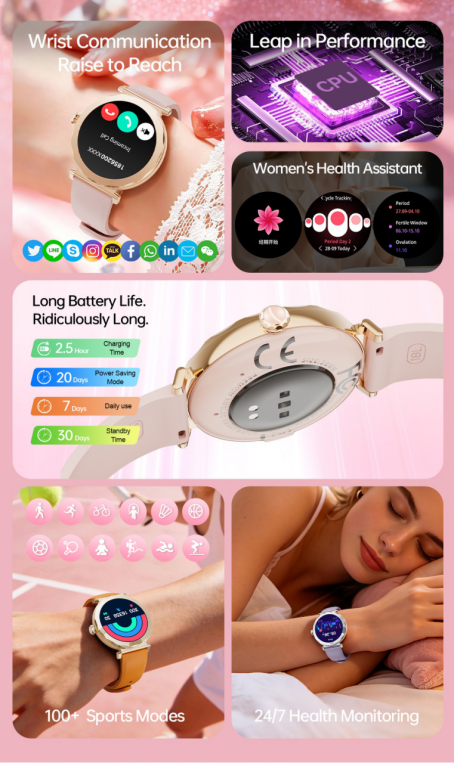
The health and daily-use story on one page: call handling from the wrist, the women's health assistant, runtime in four modes, sport modes and overnight monitoring.
Section 2: How to Compare Suppliers, Criteria, Risk Points and a Checklist
Once the case and panel decisions are settled, supplier comparison becomes a matter of evidence rather than impression. The table below sets the MT70 platform against the questions a buyer should be able to answer for any competing offer, in the order those answers affect cost and risk.
Parameter | MT70 specification | What to verify and why it matters |
Case, weight and finishes | 38 x 38 x 9 mm, 35 g with strap, zinc alloy body with IML bottom shell; silver, champagne gold, rose gold | Ask for plating process, polishing stages and a salt-spray or artificial-sweat report on finished cases; judge the finish under shop lighting, not a softbox |
Strap | Silicone strap 205 mm long, 18 mm wide, supplied as standard; stainless-steel mesh strap available as an option on the same lug | Confirm which strap is in the quoted price, and confirm the 18 mm lug so third-party straps fit and a second strap can be sold later |
Display | 1.2 inch AMOLED, 390 x 390; detail page adds DCI-P3 colour and 600 nits peak brightness | Specify panel resolution and type in the purchase order; verify brightness on a sample rather than accepting the descriptive phrase high-definition |
Control | Full touch screen plus encoder crown, with left, right, up and down swipe menus | Check crown detent consistency, that the crown does not turn under wrist flexion, and that both inputs reach the same menus |
Water resistance | IP68, stated condition 30 minutes in 1 metre of fresh water | Obtain the IP68 test report naming the model, depth and duration; confirm magnetic charging with no exposed USB socket, and exclude swimming and salt water in your copy |
Chipset and memory | AB5691 (Zhongke 5691) with 128 MB flash | Verify the chipset part number and flash size; memory decides how many watch faces and languages can be stored on the device |
Bluetooth | Bluetooth 5.3 per the Chinese column of the specification sheet, 5.2 per the English column | Settle the version in writing before publishing; the difference rarely matters in use, but a mismatch between your product page and the shipped firmware is a support problem |
Sensors | Heart rate HX3918, gravity sensor STK8321 | Ask for the optical module specification and firmware version, and test heart rate against a chest strap on two samples |
Battery and charging | 3.8 V, 200 mAh cell with a magnetic charging cradle; 2 to 3 hours to full | Confirm the cradle is included in the box and that the same cradle charges every colour variant; a cradle that only fits one SKU multiplies your accessory inventory |
Runtime | 5 to 7 days of daily use; detail page states 7 days daily use, 20 days in power saving and 30 days standby | Fix the test conditions in the purchase order: number of notifications, calls per day, screen-on time and whether continuous heart rate was enabled |
Compatibility | Android 5.0 and above, iOS 9.0 and above | Check pairing behaviour on an older Android build and on the current iOS release; permission prompts differ and both must be scripted in your manual |
Languages | 21 languages on the companion app and the same 21 on the watch | Confirm the on-device language list separately from the app list, and check that your key market is on both |
Sport modes | Over 100 modes per the detail page; the specification sheet lists sport modes without a count | Agree the count and the visible list in the purchase order, and check that the modes you advertise actually appear on the device menu |
Health features | Continuous heart rate, sleep monitoring, blood oxygen, blood pressure trend, hourly measurement, breathing training, women's health assistant with cycle tracking | Decide which claims you will publish; blood pressure and blood oxygen need careful, non-diagnostic wording in most markets |
Packaging data | Single-set weight, carton dimensions and carton gross weight are not published in the specification sheet | Request measured packing data before you book freight; these three numbers decide container loading and landed cost, and they should be quoted per project |
Two rows in that table deserve extra attention. The Bluetooth version is the only outright inconsistency between the Chinese and English columns of the specification sheet, at 5.3 and 5.2 respectively; it is a documentation problem rather than a product one, but it is the kind of detail a retail buyer will notice. The packaging row is a genuine gap: single-set weight, carton size and carton gross weight are all blank in the sheet, so freight and landed cost have to be quoted per project until measured data exists.
The six points to put in writing before you order
· Finish verification: a salt-spray or artificial-sweat report on the finished case, plus sample units in all three colours approved under shop lighting rather than studio lighting.
· Panel specification: 1.2 inch AMOLED, 390 by 390, with the part number and the brightness figure confirmed on a sample and written into the purchase order.
· Sealing evidence: an IP68 report naming the exact model, depth and duration, and a commitment that the charging path stays magnetic with no exposed socket.
· Strap programme: which strap is inside the quoted price, the 18 mm lug confirmation, and the price of the mesh option as a separate line so it can be merchandised as its own SKU.
· Runtime conditions: the notification count, calls per day and heart-rate mode used for the 5 to 7 day figure, written down so that a lower number in the field is not a surprise.
· Health-claim wording: the exact sentences you will publish on heart rate, blood oxygen and blood pressure, agreed with your market's regulator before artwork is finalised.
Where the risk actually sits
Three risks account for most of the failures in this category. The first is finish drift: plating that looks correct on the approved sample and different three months later, usually because the polishing sequence was shortened to hit a price. The second is panel substitution: a 1.2 inch AMOLED of the same size but a lower resolution, invisible in a photograph and obvious in a notification. The third is sealing assembly: a case that passes IP68 in the laboratory and leaks in the field because the gasket was fitted by hand at a different station than the one that was audited.
All three are handled the same way, by making the specification objective and by keeping an approved sample. Write the panel part number, the plating process and the test report reference into the purchase order; keep a signed golden sample in your own office; and inspect the first production lot against it rather than against the catalogue render.
Section 3: From Sampling to Bulk Order, How It Usually Works
The sequence below is the one that keeps a light-luxury watch programme predictable. It matters more than it does for a plain fitness band, because the appearance of this product is decided by physical processes that cannot be corrected after the tooling is cut.
1. Sampling
Sampling for this type of product happens in two stages, and buyers who compress them usually pay for it later. The first stage is a stock sample in each of the three finishes, silver, champagne gold and rose gold, in both the silicone and the mesh strap, so that the colour can be judged in daylight and under shop lighting. Insist on seeing the actual production finish rather than a render: the renders in any catalogue are lit to flatter the plating, and the difference between a rose gold that reads as jewellery and one that reads as copper is only visible in the hand.
The second stage is a customised sample with your logo, your default watch face and your packaging. Expect roughly two to three weeks for a customised sample once artwork is approved, and allow a second round: the first customised sample exists to find the problems, not to be approved. When you approve it, keep one unit sealed as the golden sample and photograph it under both lighting conditions, so that the reference is a physical object and an image you can send to a factory in another country.
2. Customisation and OEM/ODM
The MT70 platform splits cleanly into what must stay fixed and what can be changed per customer, and knowing which is which is the whole basis of a workable OEM conversation. Case dimensions, the plating process, the panel, the chipset, the sensor set, the cell and the sealing method stay fixed so that test reports, certifications and manuals remain valid. Bezel colour, strap material and colour, logo and its position, packaging, accessory set, default watch face, pre-installed face list and app skin are all customer-specific.
The fixed list exists for a reason worth stating once: every change to the case or the panel invalidates the IP68 report and may invalidate CE or FCC documentation, which turns a cosmetic request into a recertification project. A buyer who asks for a 40 mm version of a certified 38 mm case is asking for a new platform, not a variation, and it should be priced and scheduled as one.
On the software side, the practical customisation is the default face and the pre-installed face list. The platform ships with a watch-face market and a customisable face builder, which means you can lead with three or four decorative faces that match your brand's season rather than relying on the customer to go and find one. Also confirm, at this stage, which of the 21 languages will be on the device out of the box for your market and which will be reachable through the app, because that difference shows up in the manual and in the unboxing experience.
3. Bulk production
Production planning starts with the colour mix, not with the total quantity. Three finishes plus two strap options gives six sellable combinations from one case, and the minimum run per combination is what really constrains your order: a programme of 3,000 units split across six combinations is a different manufacturing problem from the same 3,000 units in two combinations. Agree the mix in percentages, agree which combination is the lead SKU for the first shipment, and keep one combination as the late-cycle replenishment rather than committing all six at once.
Lead time for a repeat order on this type of platform typically runs four to six weeks after sample approval and artwork sign-off, and a first order with new packaging runs longer because the printed materials and the gift box are on their own schedule. Both figures depend on the factory's position in its own season, which is why the useful number to ask for is a production slot date rather than a lead time in weeks. Packaging is the usual cause of a missed launch: the watch can be ready while the box is still in printing, and nobody notices until the ship date.
4. Quality control and delivery
Agree the inspection plan before the first production run, not after. For this product the four acceptance points that matter are appearance under defined lighting, plating adhesion, water resistance and display uniformity. Appearance should be checked against the golden sample with a written limit for cosmetic defects on the bezel and the glass, because a plated case with a visible polishing mark is a return and an unplated moulding flaw is not.
Plating adhesion is checked by the salt-spray or artificial-sweat test on finished units from the production lot, not only on the sample that was submitted for approval. Water resistance is checked by sampling from each shift rather than once at the end, since sealing failures are station-specific. Display uniformity is checked with a flat grey image at low brightness, which is the fastest way to reveal a panel with uneven backlight or a dead pixel cluster that the decorative faces would hide.
For delivery, two documents decide whether the shipment clears: the certification file, which for this product means the IP68 report plus CE, FCC and RoHS as the baseline for most export markets, and the battery documentation, since a 200 mAh lithium cell travels under dangerous-goods rules and the paperwork has to match the actual cell. The packaging data that the specification sheet leaves blank, single-set weight, carton dimensions and carton gross weight, has to be measured and quoted before you book freight; without it, the landed cost of the programme is unknown, which is where margin quietly disappears.
Section 4: Introducing the MT70 Light-Luxury Women's Smart Watch
The MT70 is a 38 mm women's smart watch built to look like a piece of jewellery at arm's length while carrying the electronics a buyer can defend in front of a retail category manager. It is offered in silver, champagne gold and rose gold, with a soft silicone strap as standard and a stainless-steel mesh strap as an option on the same 18 mm lug.
1. A 38 mm zinc-alloy case that reads as jewellery
The case is 38 mm across and 9 mm thick, in zinc alloy, with an IML bottom shell that carries the printed detail on the back. The alloy choice is what gives the bezel a polished edge with depth instead of the flat sheen of a coated plastic part, and the 9 mm profile is what keeps the watch from catching on a cuff or sitting on top of the wrist bone.
Weight, including the strap, is 35 g. In this category that number is not a specification curiosity, it is the reason the watch stays on the wrist overnight and therefore the reason the sleep data is worth collecting. A women's watch that crosses about 40 g gets taken off at bedtime, which quietly deletes half the health proposition.
Both the body and the strap are customer-facing materials decisions, so ask to see all three finishes together rather than one at a time. Silver reads as the neutral, everyday SKU; champagne gold is the one that photographs best and sells into gifting; rose gold is the one that carries a decorative or floral face most convincingly. Selling all three in one store is a merchandising decision, not a manufacturing problem, because the case is identical.
2. One platform, three finishes, two strap programmes
The MT70 ships with a 205 mm silicone strap, 18 mm wide, and accepts a stainless-steel mesh strap as an option on the same lug. On the shelf that becomes two products at two prices from one case: a silicone version for everyday and sport use, and a mesh version for gifting, occasion wear and the customer who wants a watch rather than a tracker.
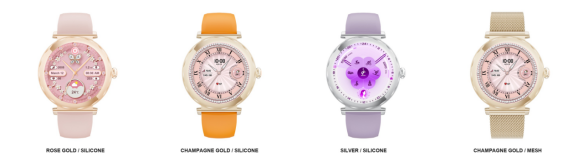
Three finishes on one case, plus the mesh option: silver with a lilac silicone strap, champagne gold with an amber strap, rose gold with a blush strap, and the champagne gold case on stainless-steel mesh.
The strap colour is matched to the case rather than held constant, which is why the same watch appears with a lilac strap on silver, an amber strap on champagne gold and a blush strap on rose gold. That matching is a merchandising advantage, because it lets a single SKU look distinctly different across a colour wall, and it is a purchasing task, because the strap colourways have to be ordered together with the cases rather than substituted later.
3. A 1.2 inch AMOLED panel that holds up outdoors
The display is a 1.2 inch AMOLED at 390 by 390. On a case this size that resolution is what makes a decorative face, with fine line work, gold accents or a photographic flower, still look deliberate rather than pixelated, and AMOLED is what makes the dark areas of those faces genuinely black.
The English detail page adds two attributes that the specification sheet does not list: full DCI-P3 colour coverage and 600 nits of peak brightness. Between them, pastel faces keep their saturation and text stays readable under overcast daylight and shop lighting. Be honest about the limit as well: 600 nits is a comfortable indoor and mixed-light figure, not a direct-sun sports panel, so keep the copy to legibility in daylight rather than readability in bright sun.
Control is a full touch screen plus an encoder crown, which gives the wearer a physical way to scroll and to adjust brightness without covering the small screen with a finger. Left, right, up and down swipes reach the first-level menu, the quick menu, the message list and the control panel respectively, so both inputs lead to the same functions rather than splitting the interface into two learning curves.
4. IP68 Waterproof, 5 to 7 days and a magnetic cradle
The watch is rated IP68, with the condition stated on the detail page as 30 minutes in 1 metre of fresh water. That is the right rating for how this product is actually worn: hand-washing, rain, a spilled drink, a sweaty class. It is not a swimming rating, and the copy should not imply one.
Sealing is helped by the charging design. The MT70 charges through a magnetic cradle rather than a pogo-pin or USB socket, which removes the most common leak path on a small case, and it also keeps the back of the case visually clean, which matters on a product where the back is printed rather than plain.
The cell is 3.8 V at 200 mAh, with 2 to 3 hours to full charge. Runtime is 5 to 7 days of daily use; the detail page breaks that out as 7 days of daily use, 20 days in power-saving mode and 30 days of standby. Those three figures are useful for different purposes: the 7 day number is the one for the product page, the 20 day number is the one for travel and gifting, and the 30 day standby number is the one that matters when stock sits in a warehouse before the season.
Calls and notifications run over a Bluetooth link, so the watch can take or decline an incoming call and show messages on the wrist, with the app handling the rest. Sensible expectations belong in the manual: a day with several short calls and a few dozen notifications will land nearer the 5 day end of the range than the 7 day end, and the test conditions behind the published figure should be agreed in writing.
5. Built for your brand
The MT70 is positioned for programmes where appearance carries the sale: a 38 mm zinc-alloy case with a jewellery-grade polish, three finishes across one body, a standard 18 mm lug that accepts both silicone and mesh, a 1.2 inch AMOLED at 390 by 390, an encoder crown, a magnetic charging path that keeps the seal, and 24/7 Health Monitoring through continuous heart rate, sleep staging and a women's health assistant that gives the sales floor a specific demonstration.
What stays fixed: case dimensions, plating process, panel, chipset, sensors, cell and sealing, so test reports and manuals remain valid. What your brand decides: bezel colour and strap colourway per SKU, logo and position, packaging and gift box, accessory set, pre-installed face list, default face, and the wording of every health claim in your market. Price, minimum quantity and lead time are quoted per project, because the colour and strap mix, the packaging and the accessory set all move cost and schedule.
Send us the target retail price, the quantity, the destination market and the colour and strap mix you plan to lead with, and the platform either fits that price or it does not; the answer is more useful than a catalogue. If it fits, a sample in two finishes, one silicone and one mesh, will tell you more in ten minutes of daylight than a page of numbers.
FAQ (Buyer's Quick Reference)
For a women's programme it is the right size: 38 mm across a 9 mm case at 35 g with the strap reads as a woman's watch rather than a smaller sports watch, and it clears a cuff. The trade-off is display area, which is why the panel resolution matters at this size. On a 15 cm wrist, which is where most of this category's customers sit, a 42 mm case borrows the watch look rather than owning it.Is 38 mm too small for a modern smart watch?
No. IP68 Waterproof covers 30 minutes in 1 metre of fresh water, which means hand-washing, rain and a sweaty session, not swimming, showering at pressure or salt water. Keep that sentence in your copy: it protects the customer and it protects the claim, and an overstated waterproof promise is one of the most common causes of returns in this category.Does the IP68 rating mean she can swim with it?
The silicone strap is the standard, and the stainless-steel mesh strap is an option on the same 18 mm lug. Because the fitting is a standard width, the wearer can change straps herself, the mesh can be sold as a second purchase, and you can refresh the look of existing stock without new tooling. Price the mesh as its own line so it can be merchandised separately.Which strap comes in the box, silicone or mesh?
5 to 7 days of daily use, with the detail page breaking it out as 7 days of daily use, 20 days in power-saving mode and 30 days of standby, from a 200 mAh cell that takes 2 to 3 hours to charge on a magnetic cradle. Where a figure lands in that range depends on calls, notifications and whether continuous heart rate is on, so fix the test conditions in the purchase order.How long does the battery actually last?
In daily use this is 24/7 Health Monitoring: continuous heart rate through an HX3918 sensor, sleep monitoring, blood oxygen and blood pressure readings presented as trends, hourly measurement, breathing training, sedentary reminders, and a women's health assistant with cycle tracking, fertile-window and ovulation prediction shown on the watch. Wording for blood oxygen and blood pressure should be non-diagnostic in most markets.What does the health side actually include?
These are quoted per project. The colour and strap mix, the packaging, the accessory set and the pre-installed face list all move cost and schedule, and packaging data for this platform is not published in the specification sheet, so freight has to be measured rather than estimated. Send target quantity, destination market, the mix you plan to offer and the certifications your market requires, and the quotation will be for the configuration you can actually sell.What about price, MOQ and lead time?
Let's Discuss Your Project
If you are planning a women's smart watch for the 2026 or 2027 season, five pieces of information make the conversation useful immediately: your target retail price, the quantity, the destination market, the colour and strap mix you intend to lead with, and the certifications your market requires. With those we can say whether this 38 mm platform fits the price you have to hit, which finishes and strap colourways can be held stable across lots, and arrange samples in both the silicone and the mesh version so the finish can be judged in daylight.
Tell us how your customers will wear it, at the office, at the gym, as a gift, and the specification stops being a table of numbers and becomes a programme you can defend on the shelf and in after-sales.
Contact us
Send your requirement through the contact details below, and include target quantity, destination market, the colour and strap mix you plan to offer and the certification documents your market requires, so that the reply is a configuration and a quotation rather than a question.
Website: www.szmorrison.com
Email: sales06@szmorrison.com
WhatsApp: +86 17318011665

Quick Links
Contact us
Categories