
How to Maintain Consistent Smartwatch Quality Across Production Batches: A Practical Guide for Wearable Brands, Wholesalers and Distributors
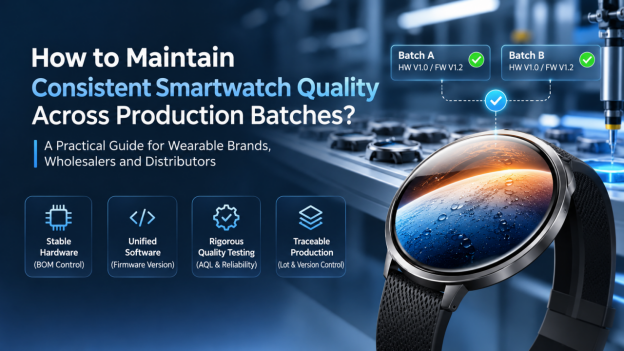
Introduction: Why This Question Matters to You
A smartwatch brand may approve an excellent sample in March, then discover that its second production batch behaves differently in June. The screen may look slightly different, the heart-rate readings may change, or the companion app may no longer pair as expected. For importers and distributors, these variations create customer complaints, inconsistent product reviews and unexpected after-sales costs.
The question is not whether a factory can ever change a component. It is whether every hardware, firmware and app-related change is identified, assessed, approved and traceable before shipment. This guide explains the most important batch-control concepts, buyer checkpoints and practical OEM/ODM workflow.
Section 1: Key Concepts Every Buyer Should Understand
A Product Model Number Does Not Guarantee an Identical Build
The same retail model name may conceal different bills of materials (BOMs), supplier lots or firmware revisions. A chip or display supplier may discontinue a part; alternatively, the factory may propose a substitute to reduce cost or improve availability. Even a visually identical IP68 elegant luxury smart watch can perform differently when the replacement component changes power consumption, screen response or sensor calibration.
Hardware Revisions Can Affect Software Compatibility
Changing an MCU, Bluetooth chipset, PPG sensor, touch controller or display driver can require different firmware configurations. A new firmware build may also alter notification behavior, workout metrics, language support or OTA procedures. Ask suppliers to record the hardware revision, firmware build, app version and BLE protocol revision together; a single vague label such as “latest version” is not sufficient.
Why Golden Samples and Change Approval Matter
A golden sample is the buyer-approved reference unit kept for comparison with subsequent batches. It should be linked to an approved BOM, device photographs, configuration files and functional test results. A controlled Engineering Change Notice (ECN) or Product Change Notification (PCN) should explain the proposed alteration, affected quantities, validation evidence and approval status before implementation.
Section 2: How to Compare Suppliers — Criteria, Risk Points & Checklist
Use these checkpoints before approving repeat orders or private-label production:
Checkpoint | What to verify | Red flag |
Approved BOM | Component maker, exact part number, approved alternates and revision history | “Same quality” substitutions without documentation |
Firmware & app | Build ID, release notes, app compatibility, pairing and OTA regression tests | Firmware replaced without notice or test evidence |
Sensor calibration | PPG sensor model, algorithm version, agreed measurement checks | Unexplained differences in heart-rate or sleep trends |
Display & touch | Panel/driver model, color and brightness limits, touch acceptance | Different appearance or response in repeat orders |
Battery & radio | Battery source/capacity, BLE stability and consistent endurance test settings | Capacity or radio changes without revalidation |
Traceability | Lot/serial mapping from components to finished units and shipments | No way to identify which customers received affected units |
Change approval | Written ECN/PCN with buyer sign-off before release | Supplier treats component substitution as an internal detail |
Trust rule: Never accept “no change” or “same specification” as a substitute for a version-controlled BOM, approved reference sample and written change history.
Section 3: From Sampling to Bulk Order — How It Usually Works
1. Sampling & Baseline Approval
Test samples using an agreed checklist for screen appearance, Bluetooth pairing, call quality, health sensor consistency, battery endurance and water-resistance evidence where applicable. Archive a golden sample and record its serial number, hardware revision, firmware build and app version.
2. Customization & OEM/ODM
Document the logo, packaging, language pack, app branding and any SDK/API requirements. Include approved part numbers, allowed alternates, firmware update policies and notification/approval responsibilities in the purchase agreement.
3. Repeat Production & Change Control
Before each order, request a batch configuration statement. If a proposed component or software change could affect performance, compatibility, certification or user instructions, require written buyer approval after an agreed validation test. Maintain clear cutover dates and lot identification.
4. Quality Control & Delivery
Run incoming component checks, in-process inspections and pre-shipment sampling against the same acceptance criteria. Compare production units with the golden sample, retain test reports and record shipment-lot identifiers so any issue can be investigated without recalling unaffected units.
Section 4: What Morrison Buyers Should Ask About Repeat Orders
For wearable brands evaluating Shenzhen manufacturing partners, a repeat order should be treated as a controlled continuation of the approved design—not as a new anonymous batch. When discussing an IP68 elegant luxury smart watch or a screenless tracker with Morrison, buyers can request the current model specifications, sample configuration and the relevant version-control arrangements for their project.
Hardware consistency: Confirm the agreed display, touch controller, Bluetooth chipset, optical sensor, battery and strap materials. Any replacement proposal should disclose the differences and the tests required to qualify it.
Software consistency: Request identifiable firmware builds, a compatibility matrix for the companion app, OTA release information and a rollback or recovery policy where supported.
Commercial consistency: Define who approves changes, which batch first receives them, whether labeling or certification documents need updating, and how warranty claims will be traced.
Buyer takeaway: A reliable OEM/ODM relationship depends on repeatable specifications and documented decisions, not a promise that every component will remain available forever. The safeguards above are recommended procurement controls; they should be confirmed contractually for each Morrison project.
FAQ (Buyer's Quick Reference)
Q: Can a supplier change a smartwatch chip or sensor without changing the model name?
It is technically possible, which is why buyers should require a revision-controlled BOM and change-notification clause. The same marketing name does not prove identical electronics.
Q: Does a firmware update always improve performance?
No. A new build may fix problems while introducing regressions in Bluetooth, battery use, notifications or compatibility. Test each release against the approved hardware configuration.
Q: How can buyers identify which batch has a problem?
Link serial numbers or production-lot codes to the actual hardware revision, firmware build, inspection records and shipment date. Without this mapping, root-cause analysis becomes much harder.
Q: What documents should I request before a second wholesale order?
Ask for the latest approved BOM/revision statement, firmware/build ID, any ECN/PCN records, golden-sample reference, regression test summary and pre-shipment inspection plan.
Let's Discuss Your Project
If you are preparing a repeat order or launching a private-label wearable, please share:
• Target market & model: intended market and reference smartwatch or fitness tracker model
• Order quantity: estimated repeat-order volume and delivery timetable
• Approved baseline: sample serial number, earlier PO and known firmware/app versions
• Technical requirements: critical component list, acceptance tests and change-approval needs
Morrison can review your project requirements, discuss applicable OEM/ODM documentation and confirm which change-control and test records can be provided before order approval.
Website: www.szmorrison.com
Email: sales01@szmorrison.com
WhatsApp: +86 147 7480 4030
WeChat: 14774804030
Shenzhen Morrison Technology Co., Ltd — Smart Wearable, Better Health.

Quick Links
Contact us
Categories