
Screenless and Faceted: How Buyers Should Specify a Screenless Sports Band for 2026 Programmes
Introduction: Why This Question Matters to You
Timing matters as much as specification this month. The 33rd APEC Economic Leaders’ Meeting is being held in Shenzhen on 18 and 19 November 2026, under the theme "Building an Asia-Pacific Community, Promoting Common Prosperity", with the APEC CEO Summit running on 17 and 18 November. Buyers from the 21 APEC economies are already in the city where a large share of the world’s screenless sports bands are engineered and assembled, which makes this week the right one to settle a screenless fitness band specification face to face rather than over email. Everything below is written to be used exactly there: in a sample room, on a factory walk-through, or in the email that follows one.
The screenless band has two very different lives in the market. In one, it is a cheap step counter sold on price; in the other, it is a slim wrist device that borrows the sculpted, hardware-key look of premium sports watches and sells on design. The second version is the one that survives a crowded shelf, because it removes the part that ages fastest (a small display) and keeps the part that sells (the silhouette, the strap and the battery life). That is the segment this guide addresses, and it is where a buyer's specification decides whether the product reads as premium or as a giveaway.

The B23 is used as the worked example because its specification is unusually explicit about the things that matter in that segment: a screenless fitness bracelet in black, blue or grey, built on a GR5515I0ND platform with Bluetooth 5.1, a 180 mAh high-voltage cell rated for 30 to 35 days of use and 50 days on standby, an HS3918 heart-rate sensor with an ST-LIS2DOCTR accelerometer, a 22 mm strap in silicone or nylon, a rated IP68 water resistance, 107 sport modes, call, SMS and social notifications through vibration, gesture photo capture, and CE, FCC and RoHS certification.
What follows is written for the buyer who has to convert that sheet into a purchase order: which lines decide the return rate, where the cost actually sits in a screenless device, what a 30-day battery claim really depends on, and how a sample becomes a repeat order. Two of the claims in this category are commonly overstated by suppliers and worth examining closely, which is why the water rating and the all-day health coverage get their own sections rather than a line in a feature list.
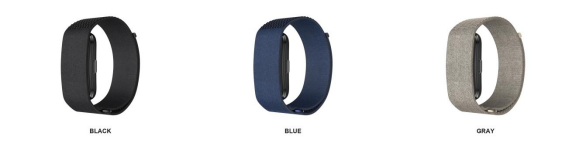
The B23 in its three standard body colours: black, blue and grey, each on a 22 mm woven or silicone strap.
Section 1: Key Concepts Every Buyer Should Understand
1. Why the faceted, screenless format still sells
A screen is expensive to buy, expensive to design around and expensive to keep current: the glass, the bonding, the driver and the UI all age, and the moment a cheaper competitor ships a brighter panel the product looks dated. Remove it and three things happen at once. The case can be sculpted rather than flattened, because there is no rectangular window dictating the outline. The bill of materials drops enough to allow a metal-look bottom case and a woven strap at a mass-market price. And the device stops competing on pixels and starts competing on how it looks on a wrist, which is a fight a well-designed band can win against a bigger brand.
The B23 uses that freedom in a specific way: a faceted case with a single side key, an IBS plastic bottom case for the part that touches the skin, and a 22 mm strap that accepts either silicone or nylon. The 22 mm lug width is the quietly important number, because it is the most common aftermarket strap size in the world: a buyer can offer the band with two strap options and let the retailer sell replacements, which is margin that a proprietary lug width throws away.
2. The battery arithmetic behind a 30-day claim
In a screenless band the run-time claim is not a marketing number, it is the whole product proposition. A device that has to be charged weekly gets taken off; a device that runs a month becomes part of the body. The B23 approaches that target from two directions at once: a 180 mAh high-voltage cell, and firmware that samples rather than streams.
The high-voltage cell is the part buyers usually miss. A conventional lithium polymer cell tops out around 4.2 volts; a high-voltage cell stores more energy in the same physical volume, which is how a 180 mAh pack supports a month of use on a case this small. The trade is that the charging path and the protection circuit have to be designed for the higher cut-off voltage, so the charger is not interchangeable with a generic cable. That is why the specification names a two-pin magnetic charging connection rather than a bare USB tail: the protection lives with the product, not with whatever adapter the end user happens to own.
The sampling side matters just as much. Heart rate is measured on an interval rather than continuously in the literal sense, notifications are pushed through vibration rather than through a lit display, and the accelerometer wakes the firmware only when the wrist moves. Those three choices are what turn 180 mAh into 30 to 35 days of working time and roughly 50 days of standby, and they are the first things to verify on a sample, because a supplier who quietly switches to continuous optical sampling can halve the number without changing the sheet.
3. IP68 Waterproof on a case with no screen to seal around
Water resistance is usually the first place a cheap band fails, and the screenless format is genuinely easier to seal than a display band, because there is no glass-to-case bond to protect. What remains is the seam between the top and bottom case halves and the charging contacts. Sealing to IP68 on a screenless body therefore comes down to two manufacturing decisions: how the two halves are joined, and whether the charging path is closed when the band is worn.
For the buyer the rating is a promise about daily life rather than about swimming. A band rated IP68 survives hand-washing, rain, sweat and a shower, which is exactly the set of conditions that decides whether the device is worn continuously. And continuous wear is not a lifestyle claim in this category, it is the precondition for every health feature on the sheet: sleep data, resting heart rate and trends all exist only if the band never has to come off for a sink.
The test to insist on is procedural. Ask which standard the rating was tested to, at what depth and for how long, and whether the check is a hundred-percent end-of-line step or a sample pulled from the lot. On a two-piece case, sealing fails at the joining step long before it fails at design, so process control is the whole argument.
4. 24/7 Health Monitoring without a display to prompt the wearer
A display band asks for attention; a screenless band has to earn it. That changes what the health features have to do. Instead of prompting the user to take a reading, the device has to measure quietly, store the trend and let the app explain it later. The B23 is built that way: a 24-hour heart-rate record, blood oxygen, dynamic heart rate, sleep quality, step, calorie and distance tracking, and an AI health report that summarises the pattern in the app rather than on the wrist.
That design has a commercial consequence worth understanding. The screenless format removes the moment of interaction that display bands use to justify their price, so the app becomes the product's face. In practice the buyer should judge the app on three things: whether the trend view answers a question a normal person asks, whether the AI health report reads like a summary rather than a data dump, and whether the language coverage fits the markets being shipped. The B23 app is Da halo, with 28 languages including the major European, Middle Eastern and Asian sets, and an OTA path for firmware updates after shipment.
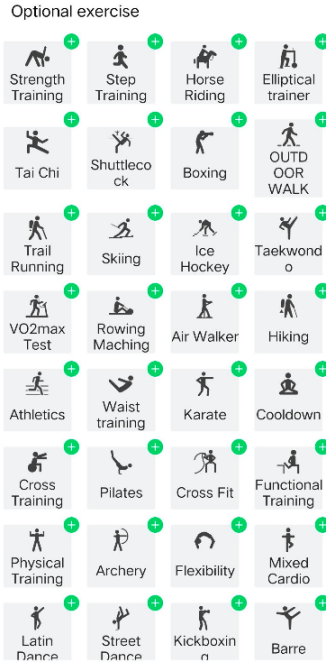
5. What 107 sport modes actually buy you
Mode counts are the most inflated line in any wearable specification, and also the easiest to test. A band that lists 107 modes but records only steps and calories for most of them is not offering 107 workouts; it is offering a menu. The question that separates the two is what the device records per mode: duration, distance, pace or heart-rate zones, and whether the record survives a sync gap.
For a screenless band the honest position is that modes are chosen in the app, not on the wrist, which suits the format: the wearer starts an activity, the band records it, and the app files it. The value of a large mode list in this segment is mostly merchandising, and the buyer should treat it that way, while checking the two numbers that do matter: the accelerometer part (ST-LIS2DOCTR on the B23) and whether step counts hold up over a known distance.
6. Notifications, gesture photo and the screenless user experience
Without a screen, notifications become a vibration language. The B23 pushes calls, SMS and social messages from Facebook, WhatsApp, Twitter and Instagram as vibration alerts, with the detail read in the app, and adds a vibration alarm and OTA updates. That is the right compromise for the format: the wearer learns that something needs attention without the band pretending to be a phone.
Gesture photo is the other feature that earns its place, because it costs nothing in hardware and demonstrates instantly in retail: a wrist gesture fires the phone camera shutter, which turns a screenless band into a remote control for group shots and tripod photos. Buyers should specify that it has been verified on both Android and iOS, since the trigger depends on camera permissions that differ between the two platforms, and that the permission flow is documented for the manual.
Section 2: How to Compare Suppliers, Criteria, Risk Points and a Checklist
Screenless bands at this price point are usually compared on the wrong lines, which is why two products that look identical in a photo can differ by a factor of two in run-time. The table below lists the lines that decide the outcome, what a credible sheet states for each, and the wording that should trigger a second question.
Specification line | What a credible sheet states | Red flag in a supplier sheet |
Product form | Screenless fitness bracelet, single side key, no display or touch surface. | Screenless claim on a band with a small panel. |
Body and strap | Black, blue or grey body; IBS plastic bottom case; 22 mm strap in silicone or nylon. | Proprietary lug width with no replacement strap. |
Weight and dimensions | Stated in millimetres and grams, measured on the approved sample. | Weight field left blank, or dimensions omitted. |
Chipset and radio | GR5515I0ND with Bluetooth 5.1 and a stated transmission range (10 m). | No part number, or a Bluetooth version that changes per lot. |
Cell and run-time | 180 mAh high-voltage cell, 30-35 days of working time, about 50 days standby. | A month-long claim from an ordinary 100 mAh cell. |
Charging path | Two-pin magnetic charging, with the protection circuit in the product. | Open contacts with no protection and no cable spec. |
Sealing statement | Written IP68 rating plus the test method used per production lot. | Water droplets in a photo and no rating. |
Optical sensor | HS3918 heart-rate sensor with blood oxygen support. | High-precision sensor, no part number. |
Movement sensor | ST-LIS2DOCTR accelerometer used for steps and activity. | Generic three-axis part with no model. |
Health set | 24-hour heart rate, dynamic heart rate, blood oxygen, sleep quality, AI health report. | Heart rate only, with trends promised vaguely. |
Activity set | 107 modes with the recorded metrics named per mode, steps, calories, distance. | Mode count with no metrics listed. |
Notifications | Call, SMS and social alerts (Facebook, WhatsApp, Twitter, Instagram) through vibration. | Call alert only, described as full notifications. |
Extra features | Gesture photo verified on both platforms, vibration alarm, OTA firmware updates. | Features claimed without a platform test. |
Compatibility | Da halo app, Android 5.0 and above, iOS 9.0 and above, 28 app languages. | App name or language count that changes per batch. |
Certification | CE, FCC and RoHS documentation available per shipment. | Certificates promised but never produced. |
Six questions worth putting in the first email, before price:
· Run-time method. How was the 30 to 35 day figure measured, with what heart-rate sampling interval and how many notifications per day?
· Cell chemistry. Is the cell a high-voltage type, and what cut-off voltage does the charging circuit use?
· Sealing process. Which standard is the IP68 rating tested to, and is the case seal a hundred-percent end-of-line check?
· Strap interface. Is the 22 mm lug a standard spring-bar fitting, so third-party straps and replacements fit?
· Notification reality. Which apps actually push to the band on Android and on iOS, given the background-permission limits on each platform?
· Certification file. Can you send the CE, FCC and RoHS documents for the exact model and firmware you are quoting?
The common thread is that a screenless band is specified by its constraints, not by its feature list: the cell chemistry, the sampling policy, the sealing process and the app permissions are what decide whether the product behaves the way the sheet says it will.
Section 3: From Sampling to Bulk Order, How It Usually Works
1. Sampling: what to test in the first ten days
A sample in this category earns its keep in the first ten days if you test four things. Wear it for a full week without charging and note the day the low-battery alert arrives, with a normal number of daily notifications; that gives you a real number against the 30 to 35 day claim. Wear it for three nights and read the sleep report each morning, to see whether the quality assessment tracks what you experienced. Walk a measured kilometre and compare the step count and distance, since step accuracy is where a generic accelerometer shows up. And put the band in a sink for ten minutes, because a two-piece case is exactly where a seal fails first.
Ask for the sample to be the production configuration: the same strap material, the same firmware build and the same cell. A sample built around a different cell or a different sampling policy is not a sample of the product you are buying, and it is the most common reason a first shipment fails an incoming test that was designed around a hand sample.
2. Customisation and OEM/ODM: what can change and what should not
On a platform like this, the split is between what carries your approvals and what carries your brand. Chipset, sensors, cell, charging path, sealing method and firmware behaviour should stay fixed across lots, because they are the basis of your certification file, your manual and your after-sales script. Body colour, strap material and colour, logo placement, packaging, accessory set, app skin and the default watch-face artwork are all fair game for an OEM programme.
Two requests are worth settling at the sampling stage rather than after artwork. A strap change from silicone to nylon alters how the case sits on the wrist and therefore the optical contact, so the heart-rate trace should be re-checked with the final strap. And a body colour change is trivial in moulding but affects the retail photo and the packaging print, so it belongs in the artwork review rather than in a production change note.
3. Bulk production: the parameters that move with volume
Volume moves three things here. Component allocation for the chipset, the optical sensor and the high-voltage cell has to be locked, because those are the parts substituted when demand spikes, and a substituted cell is the fastest way to break a month-long run-time claim. The firmware build has to be frozen with a version number, since sampling policy and notification behaviour are judged on the build you approved. And the strap and colour combination has to be finalised per market, because a grey nylon and a black silicone are two SKUs for a retailer even when the case is identical.
Everything else scales predictably: assembly, case sealing, charge and run-time check, cosmetic inspection and packing. Ask for the sealing and the charge test to be hundred-percent steps at end of line, since both failures are invisible in a sealed carton and expensive at the returns desk.
4. Quality control and delivery: the five-line inspection
A practical incoming inspection for a screenless band has five lines: a dimensional and weight check against the approved sample, because a screenless product has no screen to hide a case change behind; a run-time check on a fixed duty cycle; a heart-rate and blood-oxygen comparison against a reference device; a ten-minute water test on the sealed case; and a functional pass covering vibration alerts, gesture photo and OTA update on both a current Android and a current iOS phone.
For delivery, ask for the packing data with the purchase order: colour box format, pieces per carton, carton dimensions and gross weight, plus the CE, FCC and RoHS documents for the exact model being shipped. Those four documents are what a distributor needs to clear the product into a new market, and they are far easier to obtain before the carton is closed than after.
5. APEC 2026 in Shenzhen: turning a trade trip into a programme decision
Shenzhen is host city for the 33rd APEC Economic Leaders’ Meeting, on 18 and 19 November 2026, and for the CEO Summit on 17 and 18 November. The event lands here because the electronics supply chain is here, and that is the practical advantage for a buyer already travelling for APEC week: a screenless band specification can be reviewed, sampled and pressure-tested in one three-day block, inside one industrial belt, instead of across three time zones and six weeks of email.
The APEC calendar also hands the programme a deadline that is easy to explain internally. Procurement conversations opened around the meeting usually close sampling in the first quarter, and cartons tied to a 2027 shelf plan have to be on the water before the mid-year peak. A screenless sports band specified in December therefore has a realistic path to a completed order by March or April, which is the window most distributors in the APEC economies work backwards from.
What APEC week does not change is the paperwork. Certification is national rather than regional: CE for the European markets, FCC for the United States, and a separate registration, label and language set for every other APEC economy a distributor sells into. Arriving with a written destination list lets the certificate pack and the 28-language app coverage be checked against the same list in the same meeting, which is the part of a wearable programme that most often slips after the purchase order is signed.
If the trip is short, four items turn a sample-room visit into a decision:
· Price and quantity first. A target retail price and a first-order quantity let the build be matched to the price you have to hit, rather than to a quote reverse-engineered afterwards.
· The lead colourway. A grey nylon strap and a black silicone strap are two SKUs to a retailer even when the case is identical, so name the one you intend to lead the range with.
· The destination list. Certificate pack and app language set should be confirmed together, because those are the two lines that decide whether a carton clears customs and whether a manual is readable.
· A wear-test plan. One week of run-time, three nights of sleep data, one measured kilometre and ten minutes in a sink cover the four claims that decide a repeat order.
A specification settled in a sample room in November is still a specification that can be changed in December, and that is the whole value of the trip: the cost of a change rises every week after the golden sample is signed.


Shenzhen, host city of APEC China 2026: the industrial belt where the meeting’s sourcing conversations turn into orders.
Section 4: Introducing the B23 Screenless Fitness Band
1. A faceted case on a 22 mm strap
The B23 is a screenless fitness bracelet with a sculpted, faceted case, a single side key and an IBS plastic bottom case that keeps the part against the skin light and comfortable. Three body colours carry the range, black, blue and grey, and the strap is a 22 mm fitting available in silicone or nylon. That single dimension is the most commercially useful line on the sheet: 22 mm is the most widely supported aftermarket strap size, which means a retailer can stock the band and sell straps as an accessory line, and a brand can change the strap each season without changing the platform.
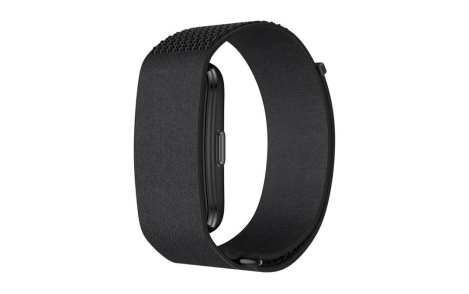
The black B23: a faceted case with a single side key, no display and a woven 22 mm strap.
2. IP68 Waterproof, a month of run-time and a protected charging path
The B23 carries an IP68 rating, and because there is no glass panel to bond, the seal lives in two places only: the joint between the case halves and the charging contacts. Worn as intended, that covers hand-washing, rain, sweat and a shower, which is the difference between a band that is worn continuously and a band that spends its life on a bedside table.
Run-time is the headline: a 180 mAh high-voltage cell rated for 30 to 35 days of working time and about 50 days on standby, charged through a two-pin magnetic connection that carries the protection circuit inside the product. That is the spec line to protect in a purchase order, because it is the one most easily broken by a substitute cell or a changed sampling policy, and the one a retailer's customers will notice first.
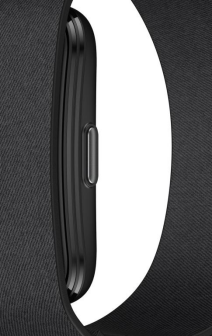
The case edge in close-up: the faceted side wall, the single hardware key and the sealed joint between the two case halves.
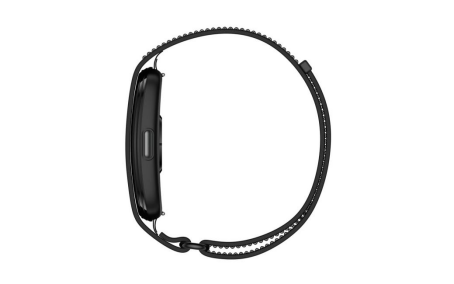
Side profile on the wrist: a slim case that stays flat under a shirt cuff, with the same single key for start, stop and notifications.
3. 24/7 Health Monitoring that works without asking for attention
There is no display to prompt a reading, so the B23 measures quietly and explains later. A 24-hour heart-rate record, dynamic heart rate, blood oxygen, sleep quality, and step, calorie and distance tracking feed the Da halo app, which turns the pattern into an AI health report rather than a list of raw values. That is the right shape for a screenless product: the wrist records, the phone interprets.
Two details make continuous, all-day health monitoring practical rather than aspirational. The first is the sampling policy, which allows a month of run-time on a 180 mAh cell only because the optical sensor samples on interval instead of streaming. The second is compatibility: the app runs on Android 5.0 and above and iOS 9.0 and above, in 28 languages, so a single build covers most of the markets a distributor will ask about.
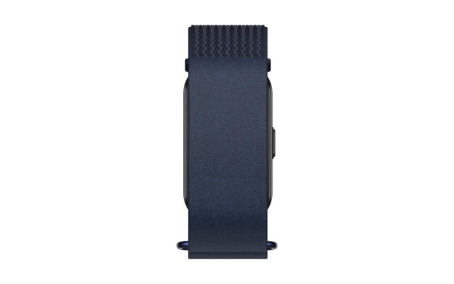
The blue colourway on a woven strap: the same case, the same key, a different finish for the retail wall.
4. 107 sport modes, vibration notifications and a gesture shutter
Activity coverage runs to 107 sport modes, with steps, calories and distance recorded as the baseline and the mode chosen in the app rather than on the wrist, which suits a device with no display. Movement comes from an ST-LIS2DOCTR accelerometer, the part that decides whether a step count holds up over a measured kilometre.
Interaction happens through vibration and gesture rather than pixels. Calls, SMS and social messages from Facebook, WhatsApp, Twitter and Instagram arrive as vibration alerts, the vibration alarm can be set in the app, and a wrist gesture fires the phone camera shutter for group photos and tripod shots. Firmware updates are delivered OTA, so a language correction or a notification fix does not require a service trip. The platform is a GR5515I0ND with Bluetooth 5.1 and a nominal 10 metre range, with CE, FCC and RoHS certification available for shipment, and the app is Da halo on both stores.
5. Built for your brand
The B23 is positioned for private-label and OEM programmes where the design language does the selling: a screenless case that reads as a sports band rather than a budget tracker, a 22 mm strap that accepts standard replacements, and a specification that a distributor can defend with certification documents. Chipset, sensors, cell, charging path and sealing method stay fixed so approvals and manuals remain valid, while body colour, strap material, logo, packaging, accessory set and app skin are matched to your market.
If your roadmap needs a different strap, a second colour or a different retail box, that conversation belongs at the sampling stage: a strap change affects optical contact and therefore the heart-rate trace, and a colour change affects packaging artwork, and both are cheaper to settle before the golden sample is signed.
FAQ (Buyer's Quick Reference)
Is the B23 really screenless, and how does the user read anything? Yes, there is no display. The band records and vibrates; everything is read in the Da halo app on Android 5.0 and above or iOS 9.0 and above, which pairs over Bluetooth 5.1 within a nominal 10 metre range and supports 28 app languages.
Can it be worn in the shower? It is rated IP68 Waterproof, with the seal concentrated at the case joint and the charging contacts rather than at a glass bond, so hand-washing, rain, sweat and a normal shower are within its intended use. Ask for the per-lot sealing test record before committing to a production run.
How does a 180 mAh cell last 30 to 35 days? Through two choices that work together: a high-voltage cell that stores more energy in the same volume than a conventional 4.2 V pack, and a sampling policy that measures heart rate on interval rather than streaming it, with notifications delivered as vibration instead of through a lit display. Standby is rated at about 50 days, and charging is a two-pin magnetic connection with the protection circuit in the product.
What exactly does it monitor, and where do the results go? A 24-hour heart-rate record with dynamic heart rate, blood oxygen, sleep quality, plus steps, calories and distance across 107 sport modes. It is an HS3918 optical sensor with an ST-LIS2DOCTR accelerometer, and 24/7 Health Monitoring here means the band records quietly all day while the app reports trends and an AI health report rather than numbers on the wrist.
Do notifications work with WhatsApp and Instagram on both platforms? Calls, SMS and social alerts from Facebook, WhatsApp, Twitter and Instagram are delivered as vibration alerts, with the detail read in the app. Background delivery rules differ between Android and iOS, so the permission flow should be tested on the current phones your market actually uses before packaging is approved.
What about price, MOQ and lead time? These are quoted per project, because body colour, strap material, packaging, accessory set and app skin all move cost and schedule. Send target quantity, destination market, the colours and straps you plan to offer and the certification documents your market requires, and we will quote against that configuration.
We are in Shenzhen for APEC week. Can we see the B23 in person? Yes. Buyers travelling to Shenzhen for APEC week, 17 to 20 November 2026, usually combine the trip with a sample visit, and one afternoon covers the three body colours, both strap materials and the two checks that matter most: a run-time test on a fixed duty cycle and a ten-minute water test on the sealed case. Book the slot before travelling, because the week fills quickly, and bring your destination-market list so the certificate pack can be prepared in parallel.
Let's Discuss Your Project
If you are planning a screenless band for a 2026 or 2027 programme, the fastest route to a useful answer is to send five things: your target retail price, estimated quantity, destination market, the colour and strap combination you intend to lead with, and the certifications your market requires. With those we can tell you which build fits the price you have to hit, which lines can be held stable across lots, and arrange a sample you can test against the run-time, sealing and health-tracking claims on this page.
Tell us how your customers will actually wear it, in the office, at the gym, in the shower, at night, and the specification stops being a table of numbers and becomes a programme you can defend on the shelf and in after-sales.
If you are travelling to Shenzhen for APEC week, say so in the first line of your email: sample-room time is easier to arrange for buyers already in the city, and an afternoon visit compresses a three-week email exchange into a decision on the case, the strap and the run-time figure.
Contact us
Send your requirement to the contact below, and please include target quantity, destination market, preferred colours and strap, and the certification documents your market requires so we can reply with the right configuration and a quotation on the same page.
Website: www.szmorrison.com
Email: sales06@szmorrison.com
WhatsApp: +86 17318011665

Quick Links
Contact us
Categories