
A 41 mm Round Case and Two Strap Systems: How Buyers Should Specify a Women's Smart Watch for 2026 Programmes
Introduction: Why This Question Matters to You
The women's smart watch is the one wearable category where the buyer is selling jewellery first and electronics second. A customer standing at a counter decides within seconds whether the case looks like a watch she would wear to dinner, and only then asks what it does. That order of judgment changes the specification entirely: the bezel finish, the case diameter, the strap options and the watch faces matter as much as the sensor set, and a product that wins on features but loses on finish does not come back for a second order.
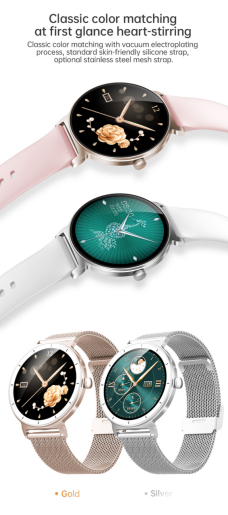
The K33 is used as the worked example because its sheet is unusually complete for this segment: a round case measuring 41 mm across and 8 mm thick, a zinc-alloy bezel finished by vacuum electroplating in gold or silver, a 1.27 inch IPS TFT display at 360 by 360 pixels, 285 PPI and 500 nits, a 220 mAh cell rated for 3 to 5 days of use and 12 to 18 days of standby with about six hours of continuous talk time, Bluetooth 5.3 with EDR for calls, a Vcare LC09A heart-rate sensor, multi-stage sleep monitoring, menstrual cycle tracking, 123 sport modes, and an IP68 water resistance rating tested to 1.5 metres.
Two things decide whether that specification becomes a repeat order. The first is the strap programme: the K33 ships with a skin-friendly silicone strap as standard and accepts a stainless-steel mesh strap as an option, which lets one case become two SKUs on the shelf, a sport version and a dress version. The second is the case finish, because vacuum electroplating on a zinc-alloy bezel is what makes a 41 mm case read as jewellery rather than as a plastic accessory, and it is also the first thing a cheap supplier skips.
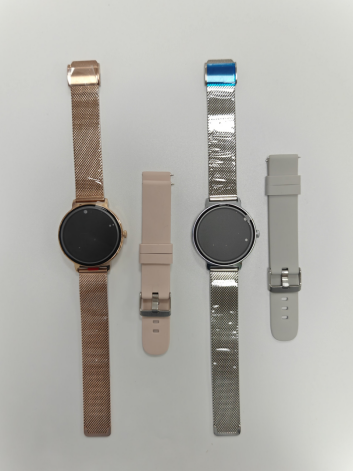
Production samples on the same 41 mm case: gold bezel with a rose silicone strap and a gold mesh strap, silver bezel with a grey silicone strap and a silver mesh strap.
Section 1: Key Concepts Every Buyer Should Understand
1. Why 41 mm and 8 mm is the size that sells
Case diameter is the single most consequential decision in this segment, and it is also the most commonly misjudged. A 44 mm case that photographs well on a marketing page overwhelms a narrow wrist in real life, and the customer who tries it on puts it down. At 41 mm the case reads as a watch rather than as an instrument, and at 8 mm it slides under a cuff, which is the detail that decides whether a woman wears it to work or leaves it in a drawer.
The material matters as much as the dimension. The K33 uses a zinc-alloy bezel with a one-piece case design and a vacuum electroplating finish, matched to the polishing standard used on entry-level jewellery. That combination is what produces a warm, deep gold rather than the thin yellow wash that a spray coating gives, and it is the reason a buyer should ask for the plating process by name rather than accepting a sentence about a premium metal finish.
2. The display maths at 1.27 inches
At 1.27 inches diagonal with a 360 by 360 pixel panel, the K33 sits at 285 PPI, which is the resolution class where text on a watch face stops looking ragged. Two numbers on the sheet decide whether that panel is usable outdoors: 500 nits of brightness and an IPS TFT panel rather than an OLED. At 500 nits the face stays readable in daylight, which matters because a women's watch is read in the street, in a car and at a counter far more often than in a dark room.
The trade of an IPS TFT against an OLED is worth being explicit about with retail buyers. A TFT costs less, holds brightness without burn-in risk, and keeps the bill of materials inside a mid-market price band, at the cost of deeper blacks and slightly more power. For a 41 mm fashion case with a bright decorative watch face, that is usually the right trade, and it is the reason a 220 mAh cell can still deliver 3 to 5 days of use.
3. One case, two strap systems: the retail maths
A silicone strap and a stainless-steel mesh strap are not two accessories, they are two products. The silicone version sells to the customer who wants a watch she can wear to the gym and in the shower; the mesh version sells to the customer buying a gift or dressing for work, and it commands a visibly higher price for the same case. Offering both from one platform doubles the shelf presence without doubling the tooling, which is the single most useful commercial line on the K33 sheet.
The lug width is 18 mm, which is a standard fitting. That has two consequences a buyer should plan for: the straps are replaceable by the customer, so a mesh strap can be sold as a second purchase, and a brand can change the strap each season without touching the case. Ask for the spring-bar specification in writing, because a proprietary fitting quietly removes both of those options.
4. IP68 Waterproof to 1.5 m on a jewellery-finished case
Water resistance in this segment is not about swimming, it is about the fact that a woman wears the watch while washing her hands, in the rain, and while getting ready in the morning. A watch that has to come off for every sink visit is a watch that gets left at home. An IP68 rating tested to 1.5 metres covers exactly those conditions, and it is the rating that lets the product stay on the wrist through an ordinary day.
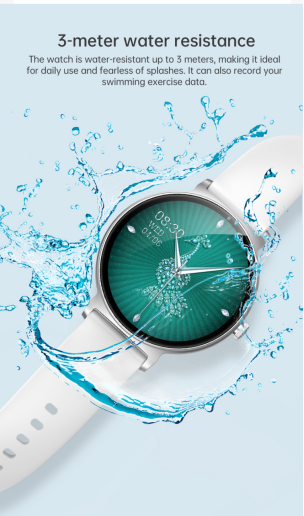
Gold bezel on a rose silicone strap: a one-piece case with vacuum electroplating, a round 1.27 inch display and a single side button.
5. 24/7 Health Monitoring for a female user
The health set on a women's watch has to be chosen for the wearer, not copied from a sports watch. The K33 pairs a Vcare LC09A heart-rate sensor with continuous heart-rate recording, multi-stage sleep monitoring that separates awake, light, REM and restful periods, and menstrual cycle tracking with reminders, all surfaced in the DA Fit app alongside breathing exercises and an optional stress score.
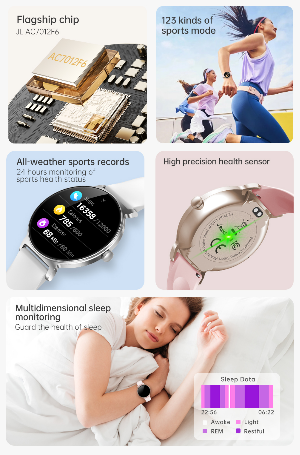
That combination is what makes round-the-clock health monitoring meaningful for this audience: the cycle record answers a question the wearer already tracks by hand, the sleep breakdown explains a night that felt restless, and continuous heart rate shows the trend across a week rather than a single reading. The commercial point is that these three features reinforce each other in the app, which is why they should be specified together rather than picked apart across price tiers.
6. Calls, notifications and 123 sport modes
The K33 is a Bluetooth-call watch, not only a notification mirror. Bluetooth 5.3 with EDR carries voice, so the wearer can answer, reject and dial from the wrist, with eight contacts stored on the watch and about six hours of continuous talk time between charges. Notifications from the usual messaging apps arrive on the display, and the DA Fit app covers weather, alarms, timers, a stopwatch, music and camera control, find-my-phone, do-not-disturb and a flashlight.
The activity set is larger than the audience strictly needs, at 123 sport modes plus step, calorie and distance tracking, but it earns its place for two reasons: it lets the product be presented to a household rather than to one customer, and it gives the sales floor a demonstration that is not only about how the watch looks. Watch faces are the other demonstration: a market of faces plus a DIY face builder means the customer can walk out with a watch that matches her outfit, and the face is the cheapest way to refresh a product that is already in the channel.
Section 2: How to Compare Suppliers, Criteria, Risk Points and a Checklist
Two women's watches that look alike in a photo can differ by a factor of three in the finish quality and by a year in the returns rate, because this segment fails on the details the camera hides: plating depth, strap quality, screen brightness and sealing. The table below lists the lines that decide the outcome, what a credible sheet states, and the wording that should trigger a second question.
Specification line | What a credible sheet states | Red flag in a supplier sheet |
Case dimensions | Round case, 41 mm diameter, 8 mm thickness, with the measurement method stated. | A diameter with no thickness, or a size that changes per lot. |
Bezel finish | Zinc alloy, one-piece case, vacuum electroplating in gold or silver. | Spray-coated die-cast case called premium metal. |
Display | 1.27 inch IPS TFT, 360 x 360 pixels, 285 PPI, 500 nits brightness. | A big screen with no pixel count or brightness figure. |
Strap programme | 18 mm standard lug; silicone strap as standard, stainless-steel mesh as an option. | Proprietary lug, or the mesh version promised without a sample. |
Cell and run-time | 220 mAh (0.874 Wh), 3-5 days of use, 12-18 days standby, about 6 hours continuous talk. | A week-long claim from the same capacity. |
Charging path | Magnetic charging at DC 5V, with the cradle supplied as a matched accessory. | Open contact pins with a generic cable. |
Sealing statement | Written IP68 rating with the tested depth (1.5 m) and the report reference. | A rating with no depth, or a report for another model. |
Platform | JL AC7012F6 with Nor Flash and Bluetooth 5.3 plus EDR for voice. | No part number, or a Bluetooth version that shifts per batch. |
Heart-rate sensor | Vcare LC09A, with continuous recording rather than on-demand only. | High-precision sensor, no part number. |
Sleep reporting | Multi-stage output: awake, light, REM and restful periods per night. | Sleep monitoring as a single line item. |
Women's health | Menstrual cycle tracking with reminders, plus breathing exercise support. | Cycle tracking claimed without the reminder flow. |
Activity set | 123 sport modes with steps, calories, distance and route record. | Mode count with no recorded metrics. |
Call and contacts | Calls answered and dialled on the watch, eight stored contacts, voice over Bluetooth. | Call notification only, marketed as a call watch. |
Watch faces | Face market plus a DIY builder, with the default face fixed per brand. | Customisation promised with no market in the app. |
Certification file | IP68 test report, CE, FCC, RoHS, REACH and nickel release documents per model. | Certificates promised but never produced. |
Six questions worth putting in the first email, before price:
· Finish process. Which plating process is used on the bezel, and what is the coating thickness and salt-spray result?
· Strap sample. Can the mesh strap version be sampled together with the silicone version, on the same case?
· Sealing evidence. Which report covers the IP68 rating of this exact case build, at what depth and duration?
· Run-time duty cycle. How was the 3 to 5 day figure measured, with how many calls and notifications per day?
· Sleep and cycle logic. How are the four sleep stages derived, and does the cycle record carry reminders on the watch itself?
· Certification file. Can you send the IP68, CE, FCC, RoHS, REACH and nickel release documents for the model you are quoting?
The thread running through these questions is that a fashion-forward watch is still specified by its engineering: plating depth, strap fitting, panel brightness, sealing evidence and the parts that make the health data credible. A supplier who can answer all six in writing is usually a supplier who can hold those answers across a repeat order.
Section 3: From Sampling to Bulk Order, How It Usually Works
1. Sampling: what to test in the first ten days
A sample in this segment should be evaluated on finish, fit and function, in that order, before price. Hold it next to a piece of real jewellery in daylight and check whether the gold reads as depth or as a thin wash, because plating is where cost-cutting happens first. Wear it for a day and check that the 41 mm case sits comfortably and that the strap does not twist at the lug. Wear it for a week and check the run-time against the 3 to 5 day claim with a normal number of calls and notifications. Then wash your hands with it on, and press the side button while wet, because the button is one of the three sealing points on a case this thin.
Ask for both strap versions as production samples, on the same case, since the mesh strap sits differently on the wrist and changes how the case is seen. And ask for the sample firmware build number, because watch faces, notification behaviour and sleep logic are all judged on the build you approve, not on the one in the marketing images.
2. Customisation and OEM/ODM: what can change and what should not
The sensible split here is between what carries your approvals and what carries your brand. Case dimensions, bezel plating process, display panel, chipset, sensor, cell, charging cradle and sealing method should stay fixed across lots, because they are the basis of the certification file, the manual and the after-sales script. Bezel colour, strap material and colour, logo placement, packaging, accessory set, the default watch face and the app skin are all fair game for an OEM programme.
Two requests are worth settling before the golden sample is signed. A different strap changes how the case presents and, on the mesh version, how the lug is loaded, so both versions should be signed off separately. And a different default watch face is trivial in software but defines the retail photograph and the packaging print, so it belongs in the artwork review rather than in a production change note.
3. Bulk production: the parameters that move with volume
Volume moves three things on this platform. Plating capacity has to be reserved, because electroplating is a batch process with a yield curve, and it is the constraint that most often stretches a delivery date on a gold-finished case. The firmware build has to be frozen with a version number. And the strap and colour mix has to be committed per market, because gold with rose silicone and silver with grey silicone are separate SKUs even though the case is the same.
Everything else scales predictably: assembly, sealing test, display and brightness check, charge and run-time check, cosmetic inspection and packing. Ask for the sealing and the charge test to be hundred-percent steps at end of line, since both failures are invisible in a sealed carton and expensive at the returns desk, and for the plating lot to be recorded against each shipment so a shade drift can be traced.
4. Quality control and delivery: the five-line inspection
A practical incoming inspection for a women's watch has five lines: a dimensional check on the case and the lug width against the approved sample; a finish check under daylight against a retained gold standard, since plating shade drift is the most common cosmetic complaint in this segment; a display check covering brightness, touch response and a set of watch faces; a run-time check on a fixed duty cycle with calls and notifications; and a hand-wash test on the case with the side button pressed while wet.
For delivery, ask for the packing data with the purchase order: colour box format, pieces per carton, carton dimensions and gross weight, plus the IP68, CE, FCC, RoHS, REACH and nickel release documents for the exact model being shipped. Nickel release deserves a specific mention on a watch that touches skin all day, because it is a market-entry requirement in several destinations and a common cause of delayed clearance.
Section 4: Introducing the K33 Round Women's Smart Watch
1. A 41 mm zinc-alloy case finished like jewellery
The K33 is built around a round case measuring 41 mm across and 8 mm thick, with a one-piece zinc-alloy bezel and a vacuum electroplated finish in gold or silver. That construction is what makes the product sit in the jewellery conversation rather than the gadget one: the plating has depth in daylight, the bezel edge is polished to the same standard as an entry-level jewellery piece, and the 8 mm profile disappears under a sleeve.
Inside the case the display is a 1.27 inch IPS TFT at 360 by 360 pixels, 285 PPI and 500 nits, which is the combination that keeps a decorative watch face readable outdoors without pushing the bill of materials out of a mid-market band.
2. One case, two strap programmes, two price points
The K33 ships with a skin-friendly silicone strap as standard and accepts a stainless-steel mesh strap as an option, both on the same 18 mm lug. On the shelf that becomes two products: a rose silicone version for everyday and sport use, and a mesh version for gifting and for dressing up, at a visibly higher price for identical electronics.
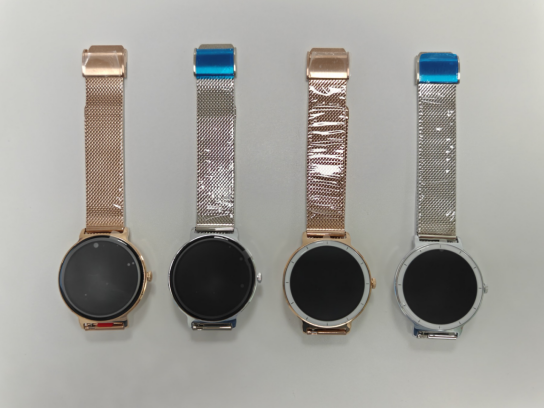
Mesh strap variants on the same case: gold and silver bezels, each with a matching stainless-steel mesh band.
Because the fitting is 18 mm and standard, the straps are customer-replaceable, so the mesh band can be sold as a second purchase, and a brand can refresh the strap each season without touching the case. That is the cheapest way to keep a product moving in a channel that has already seen it.
3. IP68 Waterproof, five days of use and a magnetic charging cradle
The K33 is sealed to IP68 at 1.5 metres, which is the level that covers the way this watch is actually worn: washing hands, walking in the rain, and a normal morning routine. The three sealing points are the glass-to-bezel bond, the side button and the charging contacts, and the rating is backed by a test report that a distributor can file with the shipment.
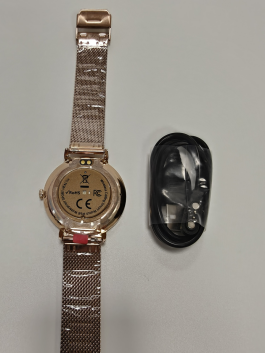
The case back: certification marks for CE, FCC and RoHS beside the sensor window, with the matched magnetic charging cradle.
Power is a 220 mAh cell rated at 0.874 Wh, giving 3 to 5 days of use and 12 to 18 days of standby, or about six hours of continuous talk time if the wearer uses the watch for calls. Charging is magnetic at DC 5V, with the cradle supplied as a matched accessory, which is also what allows the case back to stay closed rather than carrying an open socket.
4. 24/7 Health Monitoring, Bluetooth calling and 123 sport modes
Health data comes from a Vcare LC09A heart-rate sensor paired with multi-stage sleep monitoring that separates awake, light, REM and restful periods, plus menstrual cycle tracking with reminders on the watch. Presented together in the DA Fit app, that set is what makes all-day health tracking useful for this audience: the cycle record replaces a manual calendar, the sleep breakdown explains a night that felt restless, and the continuous heart-rate trend shows a week rather than a moment.
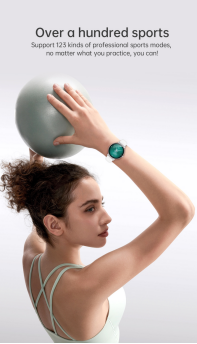
Silver bezel on a white silicone strap, with a decorative face from the watch-face market.
The watch is also a call device rather than only a notification mirror: Bluetooth 5.3 with EDR carries voice, so incoming calls can be answered, rejected or dialled from the wrist, with eight contacts stored on the watch and the display showing the caller. Face market and a DIY builder sit on top of that, along with weather, alarms, timers, stopwatch, music and camera control, find-my-phone, do-not-disturb, a flashlight and a calculator.
Activity coverage runs to 123 sport modes with steps, calories, distance and route records, which lets the product be presented to a household rather than to a single customer, and gives the sales floor a demonstration beyond how the watch looks. Languages are handled on both sides, with the watch interface selectable across the major European, Middle Eastern and Asian languages, English as the default, and the app covering a comparable set. Firmware updates are delivered OTA, so a language or face correction does not require a service trip.
5. Built for your brand
The K33 is positioned for private-label and OEM programmes where finish and strap range do the selling: a 41 mm round case with a jewellery-grade plating process, a standard 18 mm lug that accepts both silicone and steel mesh, a display and sensor set that can be defended in front of a retail buyer, and a certification file that includes an IP68 report, CE, FCC, RoHS, REACH and nickel release.
Case dimensions, plating process, panel, chipset, sensor, cell and sealing method stay fixed so approvals and manuals remain valid, while bezel colour, strap material and colour, logo, packaging, accessory set, default watch face and app skin are matched to your market. If your roadmap needs a different default face, a bundled second strap or a different box, that conversation belongs at the sampling stage, where it costs an artwork revision rather than a production change.
FAQ (Buyer's Quick Reference)
A 1.27 inch IPS TFT panel at 360 by 360 pixels, 285 PPI and 500 nits of brightness, in a round 41 mm case that is 8 mm thick. Between the resolution and the brightness, watch faces stay legible in daylight, which is where most of this watch's reading happens.What size is the display, and is it bright enough outdoors?
The skin-friendly silicone strap is the standard configuration and the stainless-steel mesh strap is an option, both on the same 18 mm standard lug. Because the fitting is a standard size, customers can change straps themselves, and a brand can offer the mesh version as a higher-priced SKU on identical electronics.Is the mesh strap included or optional?
Yes. It is rated IP68 Waterproof to 1.5 metres, covering hand-washing, rain and an ordinary morning routine, with the seal concentrated at the glass-to-bezel bond, the side button and the charging contacts. The claim is backed by a test report that can be filed with the shipment.Can she wear it while washing her hands or in the rain?
A 220 mAh cell rated at 0.874 Wh gives 3 to 5 days of use and 12 to 18 days of standby, or about six hours of continuous talk time. Charging is magnetic at DC 5V with a matched cradle, and the real-world figure depends on how many calls and notifications the wearer receives, which is the variable to fix in the purchase order.How long does the battery last with calls?
Heart rate continuously through a Vcare LC09A sensor, sleep in four stages (awake, light, REM and restful), and menstrual cycle tracking with reminders on the watch, alongside steps, calories, distance and 123 sport modes. In the DA Fit app that becomes 24/7 Health Monitoring, with trends rather than single readings.What does it monitor, and does it handle cycle tracking?
These are quoted per project, because bezel colour, strap version, packaging, accessory set and app skin all move cost and schedule. Send target quantity, destination market, the colour and strap mix you plan to offer and the certification documents your market requires, and we will quote against that configuration.What about price, MOQ and lead time?
Let's Discuss Your Project
If you are planning a women's smart watch for a 2026 or 2027 programme, the fastest route to a useful answer is to send five things: your target retail price, estimated quantity, destination market, the colour and strap mix you intend to lead with, and the certifications your market requires. With those we can tell you which build fits the price you have to hit, which lines can be held stable across lots, and arrange samples in both the silicone and mesh versions so the finish can be judged in daylight.
Tell us how your customers will wear it, at the office, at the gym, as a gift, and the specification stops being a table of numbers and becomes a programme you can defend on the shelf and in after-sales.
Contact us
Send your requirement to the contact below, and please include target quantity, destination market, the colour and strap mix you plan to offer, and the certification documents your market requires so we can reply with the right configuration and a quotation on the same page.
Website: www.szmorrison.com
Email: sales06@szmorrison.com
WhatsApp: +86 17318011665

Quick Links
Contact us
Categories